Tag Archives: mentalhealth

I Was Wrong

For the last few months, I have taken a deep plunge into healing. After years of therapy from all different modalities, I found very little difference. My life would be fine and “functional” for a few years, only to be followed by an inevitable crash. I’ve been through this cycle for most of teens and all of 20s. Each time, I picked myself back up only to white-knuckle my way through “functionality”–until, the inevitable crash.

For so long, these “crashes”—long periods of depression, psychosomatic symptoms, and lapses of complete dysfunction–seemed unrelated. I would excel in work, friendship, and relationships only to lose all of them. Time and time again, I felt dejected, humiliated and utterly worthless.

Why do I keep messing it up? What is wrong with me!?

In the aftermath, I sought out help–only to help me get back on my feet again and once I felt “ready” enough, I plunged in headfirst into work, relationships and life with even more resolve and stubbornness.

I can’t let him win. I can’t let trauma win. I HAVE to do it right, this time!

Yet, I couldn’t. I couldn’t do it in a sustainable manner.

For decades, I deluded myself into thinking that I could “white-knuckle” it through life. I danced between diagnoses, swapped out medications, changed therapists, implemented new strategies from the self-help book of the season; yet, every single intervention yielded minimal results.

This year, I was forced to face the lingering effects of unaddressed trauma; my body gave me no choice. The unprecedented seizures, fainting episodes, and gaping lapses of memory loss jilted me to my very core. I was desperate, in more ways than one. Some days, I was more scared of the seizures and syncope episodes; other days, I found myself begging God that they take my life.

I found myself in an impossible situation where I was equally scared of death and of life

It was this very predicament that finally brought me to the doorstep of surrender. I didn’t know what more to do; every willful intervention of mine had not worked. I didn’t want to die and I certainly was not living. I thought if I was just strong enough, stubborn enough, knowledgeable enough…I would be able to “beat it”. In my case, knowledge was not power. I went to school to get a masters degree in psychology; I studied the ins and outs of different modalities & dissected the interventions of esteemed theorists. As a counselor, I became adept in helping others navigate through their own hardship and grief–but I could do nothing for myself.

Knowledge, in my case, was my Achilles. It brought me hubris, and an unhelpful sense of intellectual arrogance. My training in counseling and psychology bred an avid resistance to be treated. I thought I knew better, so I refused the treatment prescribed for me by other mental health professionals.

But, knowing better doesn’t always lead to doing better.

There is a reason that mental health professionals and doctors cannot treat themselves or their loved ones. Sometimes, we are just too close to the subject. In my case, I was the subject and could do very little to help. There is a reason “blind spots” are called just that. We cannot pinpoint them using our own biased way of thinking.

The problem cannot be solved using the same mind creating it.

In June of this year, I finally got to a point where I could no longer tolerate the suffering. Now, I have come to realize that the suffering was being perpetuated by my relentless need to be in control.

We must let go of the need to control to gain it.

Five months ago, I begrudgingly started the process of EMDR. Despite years of others suggesting it for me, I resisted it at all costs–all because, I simply did not know how it would work. I had no faith in the process. How could moving my eyes a certain way help unpack layers of complex trauma? It honestly sounded laughable.

Yet, here we are.

I am no where close to being “healed”, but the beautiful paradox is that I’ve let go of the idea of being “healed.” It is no longer some faraway, unachievable destination that torments me; it is here, and now. Throughout the EMDR process, my healing has been anything but linear; it has ebbed and flowed with life itself, and there is infinite beauty in that. I no longer find myself fantasizing of a perfectly “healed Maham”; I no longer torture myself by comparing my “now” to that preconceived ideal.

My suffocating grip on the rigid definition of “healing” has loosened.

Day by day, I’m learning to experience myself as I am. And, dare I say, life would not be intolerable if I remain who I am today, for all of my days. The rigid parameters I placed around creating “a good life” are slowly dissolving. These days, progress seems far more promising than perfection; I find myself welcoming minor setbacks as necessary precursors to growth and “healing”.

I am starting to assess “healing” by my ability to tolerate feeling.

Bit by bit, I am starting to work through unspeakable pain. In doing so, I’m finding acquaintances in connection, love, and even ephemeral joy.

Nowadays, I find that even gratitude chooses to sit by me sometimes.

Thank God, I don’t have all the answers. Thank God, I don’t understand everything. Thank God for the realization that I never had to.

Thank God, I finally had the courage to be wrong.

— because of it, I’m finally being led to what feels right.

Another Notch on the Belt

By: Maham Abid

The creaky office felt sterile and cold.

My brimming anxiety grew into something bold.

One more visit down—another notch on the belt,

What’s wrong isn’t always clear to see, but it is deeply felt.

It keeps being suggested that it is “all in my head.”

But if that’s really so, why is my body responding with distress?

I admit I can be neurotic and full of unnecessary fear,

But I’ve lived most of my life with anxiety looming near.

That’s precisely how I identified these new symptoms as severe.

I am no stranger to silently analyzing the absurdity of my worry.

So, how ironic is it that when I finally speak up, I’m dismissed in such a hurry?

Why won’t someone validate the sensations that I feel?

I have no ulterior motive; I just want to heal.

So today, as I sit stiffly in yet another sterile waiting room,

My mind can’t help but wander off to similar memories of gloom.

This doctor, too, shall say that he can’t specify what’s wrong.

And refer me for more poking & prodding–which will only prolong–

–me suffering silently, trying to make sense of what is really going on.

This entire process has felt like crazy-making at its worst,

The constant dismissal of my symptoms feels like a curse.

Is it ungrateful of me to almost hope they find something soon?

So I can finally get some reprieve from the sense of impending doom?

Of course, I don’t want it to be something that doesn’t have a cure.

What I desire is external proof to validate my intuition for sure.

At any point now, another physician will walk in.

He will talk at me in medical jargon that’ll make my head spin.

I know our dear doctors see innumerable patients every day,

but communicating genuine care is not an ethic to be pushed away.

I understand that sometimes answers are complex and hard to find,

But perhaps being transparent with me won’t leave me feeling as resigned.

How is it that the people with the most knowledge of all,

–are the very ones that leave so many feeling unheard and small?

“Something is wrong!”, my intuition cries.

“I’m truly not here based on fabricated lies.”

It is okay for professionals to not have all the answers quite yet,

but empathy and care are traits that no human should forget.

If we continue to view our patients as “just another one”,

We will, carelessly, add more damage to what was already done.

#NotAnotherNotchOnTheBelt

Love you always, all ways

IG: @mahamabidtalent

Youtube: https://www.youtube.com/@mahamabidtalent

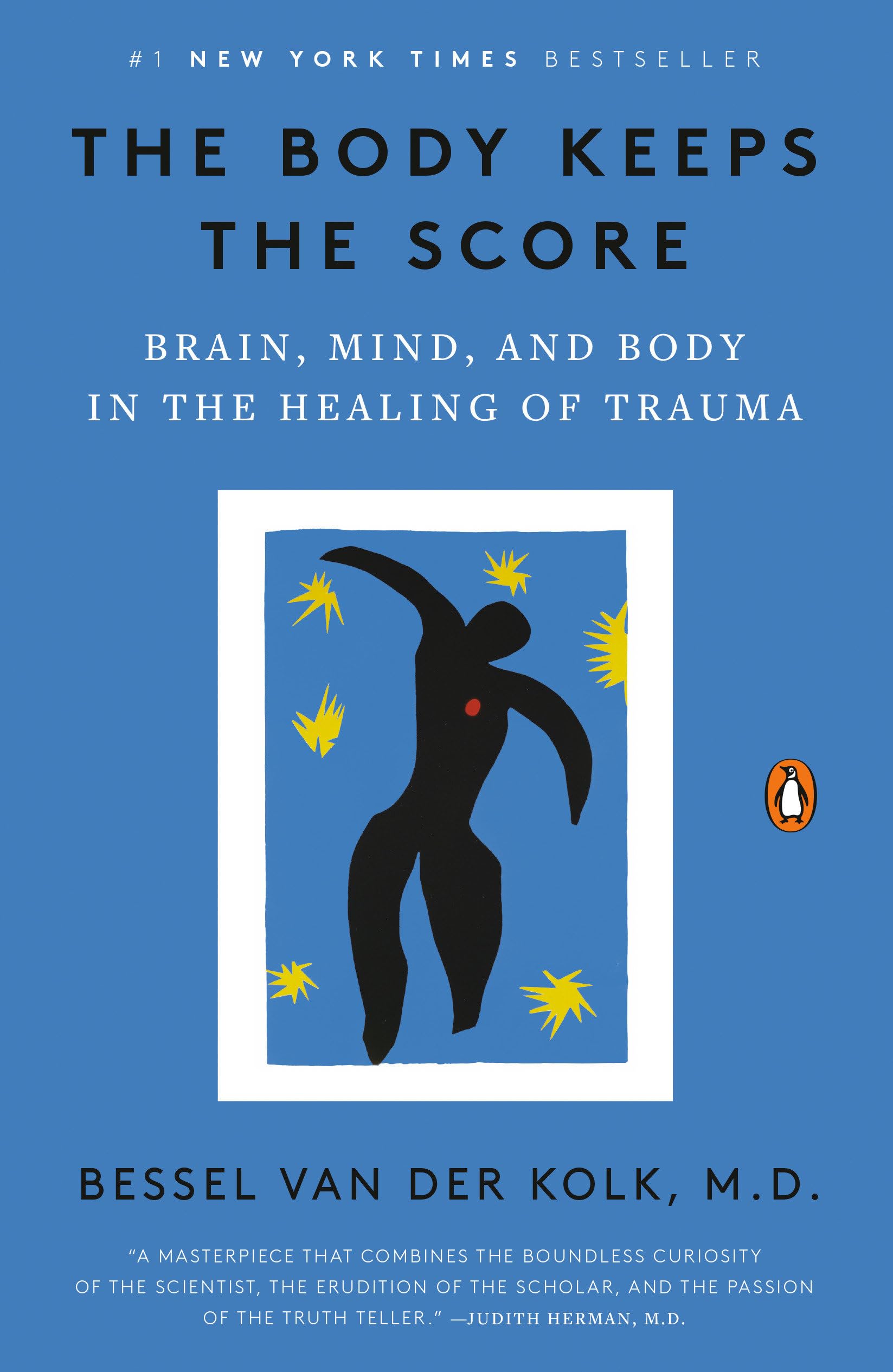
The Body Keeps Score

And track of your bullshit too (unfortunately)

Ya’ll I started reading again. I immediately regretted it. I came across this rattle snake quote:

“The greatest source of our suffering is the lies we tell to ourselves.”

Dr. Kolk, you nearly gave me a heart attack with that quote.

And then…you used it twice?

To make sure repressed memories had not just one–but two chances to pester me?

I see your subliminal messages, Kolk, I see you. Lol.

Anyway, I started re-reading “The Body Keeps Score”, a book by Dr. Kolk (MD) who offers sturdy evidence supporting the psychosomatic model of wellness. I admire how the book reminds us to view the human being through a wholesome, holistic lens– especially when tailoring treatment and interventions from a psychological, spiritual and physical standpoint. Furthermore, in his book, he manages to brilliantly unpack trauma in a way that is accessible to the touchy population that struggles with it, day in and day out. It is easy to follow, written objectively, and therefore, most importantly, explains and “unpacks” trauma and its effects in a a way that is NOT retraumatizing.

THE FIRST YUCKY EXPERIENCE

So anyway, back to my first re-stab at figuring out why this quote elicited such a disharmonious yet congruent feeling from deep within a crevice of my soul?

“The greatest source of our suffering is the lies we tell to ourselves.”

In this revered book, “The Body Keeps Score”, Dr. Kolk refers to the preceding quote, not once–but twice. I wish I could say that the first time I saw it, I just glazed over it, giving it no attention; I truly wish I could tell you my mind’s ability to repress sh*t was stronger than my body’s ability to react to the sensation it evoked. I think that I would have found some solace is NOT being able to relate to the quote, despite how abstractly I did. It would have confirmed my bias because I could use my detachment as “proof” to myself that it really is “mind over matter” and in this case, “mind over body and trauma.” But…that would keep me in denial (which is an area I apparently love hanging out in)… and it would also kinda go against the very premises of the book he wrote 🙄

Dr Kolk’s very research builds its case on an overarching and (most likely true) assumption. Like many other social scientists and neurobiologists, Kolk implies that no matter how arduously the mind tries to make us forget about big feelings, the body doesn’t just simply follow suit and “forget” too. This phenomenon is so evident in the recollections of relentless flashbacks experienced by so many PTSD warriors. It is such an odd feeling. One second, our day can be going fine and dandy then one flipping sensory cue later–like a certain quote, a phrase, a sound, someone’s voice, a fragrance, a temperature fluctuation, a visual cue, the cadence with which one talks… any sensory “trigger”– which may seem miniscule and relatively insignificant has the capacity to bring with it a torrential tsunami of sensory and affective overload that is so typical to trauma.

So…. long story short–no. I can’t, with full honesty, say that I was able to simply skim over that quote without feeling any connection to it, regardless of how distant it felt at first. The truth is the words literally caught my attention. The first time I saw the quote was on page 11.

“The greatest source of our suffering is the lies we tell to ourselves.”

I read it, it made me stop. That means a lot to me.

I also know that when it comes to quantifying something, phrases like “a lot” and “a little” are subjective measurements of that are so variable and therefore unhelpful. So let me rephrase– for me, having a random “quote” elicit some abstract “sensation/feeling” out of me that I couldn’t even pinpoint long enough to make me cranky was pretty remarkable.

I don’t think you realize how severe my inattentive subbrand of neurodivergence is.

On that topic, for something to really stop my inattentive, million mph mind in its tracks, even for a few seconds--it means a lot. It was the first sentence in this book that made me truly pause. It left me speechless.

The first time I came across the quote, it simply resonated with a repressed subconscious part of me. It’s almost as if when I read it, a deeply buried part of myself echoed back out, noting, “hmm…how peculiar–I wonder what parts Maham’s brain is hellbent on hiding from her…and why?”

The quote read me. I didn’t read the quote. 

I swear, I’m not trying to sound like Yoda; I’m trying to use words and language to effectively capture and hopefully, convey the eerie experience of association i had with that quote. Reading it…reminded me of something very familiar–like deja vu. Okay, so most of ya’ll will understand this example–its the same, unexplainable, intuitive feeling that you get when you meet an absolute stranger–and in that moment, you don’t know how and no reason to logically think why, but you FEEL and KNOW that this person is going to come to mean something so important to you one day. Maybe the experience is a result of Carl Jung’s “collective unconscious” giving us a kick in the behind saying we’ve experienced their energy in a past life…or maybe the experience is to activate our fight or flight reflexes to run because we are running into the next Ted Bundy reincarnated–I don’t know. I deflect. 

THE SECOND, EVEN YUCKIER EXPERIENCE

Anyway, the SECOND time I happened to “stumble” upon Dr. Kolk’s accidental use of the same eerie quote on page 27, it came together. I felt, understood, and remembered why the quote struck such a deep discordant chord within me. My thoughts, feelings, and sensorimotor recall reintegrated to form a cohesive memory that I could call upon.

That’s the irony in trauma–the very experience of it impairs our prefrontal cortex functioning, which is responsible for a lot of higher order thinking skills. Sometimes I feel like trauma created this weird delay between my right and left brain conversations. Anyway, on page 27, the second time I read the quote, had given my right brain sufficient time to get in contact with its left counterpart, very temporarily turning on my and my executive functioning skills.

What the pedantic jibberjabber above pretty much says, is that my mind finally caught up to my body, and I understood why the same quote had evoked a disconcerting and gut-wrenching feeling when I first read it on page 11.

“The greatest source of our suffering is the lies we tell to ourselves.”

“Well,” I had initially thought, “what lies am I telling myself?”

“Um…none–” is what my my frantic flight-or-flight response had impulsively interjected, fearing that we may be getting “warmer” to the truth.

The book talks about how since the greatest sources of our suffering are the lies we tell ourselves, then healing must essentially lie in us becoming rigorously honest with ALL parts of ourselves. That can be particularly hard in individuals whose chronic struggle with cPTSD has resulted in large degrees of dissociative episodes that are sprinkled with larger and larger time periods they have no recollection of. Because, to be completely honest, I feel like I have realized the “lies I’m telling myself” before in therapy…I just think, they are too painful to sit with. We are all strong enough to face our demons for a brief period, until the human brain launches its super power of self-preservation power and despite realizing what’s holding you back, you also simultaneously know that you WILL MOST CERTAINLY FORGET any truth that can help you make true progress very SOON.

So, putting my judgement aside, I reread the quote, and thought about it. “Seriously, all bull**** aside, Maham,” I asked myself, “What is going on?” What am I hiding from myself? I mean, clearly knowing me, if I’m hiding it that strongly from myself, it probably has something to do with a lot of shame–like a crippling amount of shame that I can’t psychologically handle without the possibility of fracture. Dr. Kolk talks about this agonizing shame as a hallmark among most PTSD survivors, despite the inherent variability seen in their respective traumas. The complex nature of trauma does not help, as oftentimes, survivors snap and react in ways that are not characteristic of themselves immediately after a trauma; it is usually the aftermath of the moment in which the psyche fractures. (Yall, there is a great Tyler Perry movie on Netflix about this called “Straw”–>Watch it!)

Shame could come from the actions one did/did not do to protect themselves in their situation, and yet shame could also come from dealing with with isolating stigmas, and ostracizing cultural narratives. The sources for the tormenting shame felt by trauma survivors are myriad in nature, however, the palpable presence of the dementor that is shame in all those who have experienced PTSD is a great starting point for further research.

As I sat with the quote longer, my stomach dropped.

Why do I refuse to eat? Why do I not want to live? What am I not forgiving myself for?– so much so that I want to punish myself by barely getting by?

The intrusive thought/s just popped into my head, and gave birth to a million other equally disturbing tangential thoughts. Because clearly, the one thing all my doctors, despite their specialty, can agree on is that:

I am slowly killing myself by depriving myself nutritionally in a chronic manner; it is not suicide that is imminent. It is a confounding and tragic type of slow existential death.

And it is a painful and slow death.

It looks like a period of it “just staying all in your head”, until it isn’t. Then, much like it happened for me, cute new little symptoms start emerging as physiological manifestations–but they are just psychosomatic manifestations of the same age-old psychological struggles I’ve been going through for the last three decades.

Maybe my shame lies in knowing how avidly I pursued higher education grasping at any information about trauma and its insidious impacts. I think I did in this in an attempt to “get ahead of it” and not let the trauma I felt brimming under the surface affect me. Perhaps the source of my shame results from KNOWING better and yet choosing not TO DO better…even though I think some part of me always knew there was a different way…. one that had worked for many before me.

Accumulating all the “academic knowledge” about human behavior and life after trauma, my mind still remains just as hellbent on unseeing the fact that I am literally the textbook case of the subjects we read about in our graduate courses who presented with CPTSD!

My stubborn mind refuses to believe that yes–trauma can even catch up to me, Maham Abid. My comprehension about it on a “cognitive” level does not imply that my knowledge of trauma ever translated into wisdom.

If it had, I would’ve been able to help myself from repeating the same agonizing cycles that have left me crippled with shame. “Insanity is doing the same thing, over and over again, expecting a different result,” right?

So when I read the quote on page 27 again, I tried delving past that initial recognition, and tried to connect to it more intimately. Leaning into it was not fun. It created that nasty, “crawling out of my body” sensation whose origin my mind couldn’t quite connect to or trace. I think the sensation highlighted the stark difference between how “well” I convince myself I am handling my trauma versus how “unwell” I’m actually coping with it… like, at any given moment of time. I mean, a lie I definitely perpetuate is that I, unlike all the other people I have studied about, can somehow magically go through years and years of jarring trauma and come out of it, unlike everyone else, completely unscathed.

The assumption I’m trying to highlight is the inaccurate notion that knowing better or cognitively understanding something better results in doing better. I always tend to underestimate how deeply pervasive the effects of my own residual trauma are. Likewise, I tend to overestimate how “fast” I can have recovered from some really horrific things–while in actuality, I’m only ever really putting band-aids over a gaping wound.

My amazing psychiatrist (yall, she’s put up with me for almost a decade), has told me before, so eloquently and concisely what the problem is. Years ago, she told me:

“Maham, I can keep your body alive (to some extent) using these medicinal interventions…but that’s not saying much. The rest is up to you.”

Alright, brain = explode

More deep dives into the dearth of dreary discordant dissonance later.

Hasta luego,

More bones to pick with you later, Dr. Kolk 😋

Fragments

April 19th, 2025

Most days, I feel as if I’m grasping at straws,

like a cat gripping the edge of a well with all her claws.

But, unlike her, if I manage to get out–

I can’t trek this Earth without fear and doubt.

It feels as if someone swirled a ladle inside my brain.

The memories–cracked and fragmented–yet the pain remains the same.

The resourceful rescuer that lives in my head–

–has tried its hardest to put the tormenting thoughts to rest.

But the benevolent body–it never forgets.

It may silence the screams, but it stores them as stress.

Version 1.0.0

Then, one day, when nothing seems to have gone awry at all–

–as the trees shed what is dead, and autumn leaves begin to fall.

A piercing cry echoes through the crisp air.

The horror in her howling is almost too much to bear.

“Someone needs my help!”; so I search frantically around to see–

–only to find that the bleeding bellow escaped from none other than me.

Returning to Myself (Part I)

To the person I have loved the most—-

They say it is better to have “loved and lost” than to never have loved at all.

 I disagree.

I lost myself in you.

I almost lost myself TO you, literally.

You killed me once.

 The problem, you see, is that I followed faithfully in your footsteps.

I chose to stay.

I chose to retell, repeat, and relive the tormenting narrative you created for me.

I chose to kill myself, slowly—arduously—painfully—every single day—for decades.

Until now.

For as long as I can remember–my life, both figuratively and literally, has been in your hands.

As I sit here, sifting through the decades of dejection, I can wholeheartedly tell you that no person is worth sacrificing your sanity.

Day one or “one day…”?

Its finally day one.

Today is the day I finally let go.

I am shakily, and finally choosing differently.

& do you know the most pathetic part?

I am so scared.

Believing the delusion that your violence might have been “love” is far easier than accepting the fact that the “love” I romanticized was never there at all.   

I am so deathly afraid to let you go—

—even though you have been the most toxic, unhelpful relationship in my life…

I feel fear.

& it’s not because of the alternating black eyes, hushed bruises, or broken bones…

Those heal.

I’ve watched too many of them fade from my body like mirages on a hot day.

I trace my fingers over the ever-so-familiar, black-blue spots I’ve, now, come to find disturbing comfort in.

But they’re gone—

All that remains is the eerie echoes of your query whispers.

“If you looked like (her) _____, or carried yourself like (her)_______, then I wouldn’t be beating you…” you echo menacingly through time, “the reason I’m doing this is because there is something INHERENTLY wrong with you. You deserve this.”

Your words ring in my brain– taunting me, haunting me— till the singular motivation becomes about escape—

I must outrun the crippling hatred erupting relentlessly within me.  

And over decades of deterioration…I have tried to “escape”.

But I have no room to talk. You were right–

 I couldn’t even succeed at the one thing you’ve told me I should have always done.

The truth is, as you say, I am a coward.

I am spineless, identity-less, and lower than the scum on the bottom of the pond..

I couldn’t do it successfully. I came very close.

But “almost” doesn’t cut it.

Who expected a service dog to lounging silently on a neighbor’s porch on a freezing December night?

2020

I ran 5 miles at my fastest pace–

My avid runners–ya’ll would be so proud of my splits!!!

I even beat my PR (personal [best] record)

& after approaching fatigue…I looked around to double check that no one was within sight.

& in the deafening silence of the night…

I carefully wrapped the ankle weights I use for strength training around my weary legs…

And I….jumped…into the deepest pond I had scouted out a few weeks before.

The clock had struck midnight—it was finally my birth “day”…December 4th.

The paralyzing pressure of the water, the languish in my legs, and the curling coldness enveloped me as I was unable to swim to the surface.

And the last thought I remember thinking, as I sank slowly to the bottom

—was tragically about you.

I thought about your cruel words.

“If you want to do the world a favor, Maham…”, you snarled in my slowing brain “just go ahead and do what is needed to be done”

And…. I couldn’t do it.

But I tried.

That damn service dog had alerted his owner with his incessant barking–causing a complete stranger to walk out–and see what was happening. 911.

“Just do it! kill yourself.” I heard under the murky, dark water.

My arms, naturally, fought to try to get to the surface.

But I couldn’t.

It was getting harder and harder to breathe.

I could feel my my lungs give out.

…and I fought—when it came down to it–I FOUGHT to try to get back up to the surface….

Until I heard the final echo of your voice that night….

“Everything you touch turns to misery anyway.”

I heard those last demeaning words…and I stopped fighting.

In that moment, I made the decision to let go.

I let flailing arms fall to my side and closed my eyes as I sunk towards the bottom.

& that was my last thought before losing consciousness.

The next thing I remember is waking up on the grass, on a stretcher, surrounded by EMTs pressing on me—and there it was—OUCH!!!!

All of a sudden, I was yanked back into reality—

–I was choking on the water that was, then, fervently flooding out of my mouth and nose at an unbearable pressure.

I have a momentary snapshot of me wrapped in a bright silver insulating blanket.

& I lost consciousness again…

I was struggling with hypothermia…[as I would come to find out later’

And finally…

I awoke in the ER..

I looked around, absolutely bewildered and puzzled.

& before I could fully become aware of what had happened, a deeper realization struck a chord so deep in my heart.

‘I am a failure’–I thought to myself. And I was. And I may still be. I was a failure in every sense of the word—.

I couldn’t even kill myself “right”.

But neither could YOU.

“I wish he had taken away your life when he ‘allegedly’ took your virginity,” I hear you screaming in my mind.

If anything, you have made it painfully clear that your life (and the lives of many others) would be a lot “bit brighter” without my presence.

“If you weren’t such a whore…then maybe you wouldn’t have gotten raped,”…

–at 14 years old—-with a knife–

Yes. The knife was utilized to “pop” my cherry.

To you, however, that’s irrelevant. It’s impertinent.

It is always my fault.

It has to be.

If I want to keep you in my life, I must always “dim” my light so you can shine brighter.

and so it begins…yet again…

An assortment of your agonizing remarks cycle through my head—at a merciless speed—

—over and over again—

My brain gets stuck on repeat like a broken record playing the same few tunes repetitively.

The tunes of my record are the stuff of nightmares.

The torment of your insidious insults continues till I want to rip my own head out of my body.

HELP!!!!!!

No human can stay immune to the missiles of such fiery self-hatred forever…

So what does one do when that unrelenting, merciless abuse starts to come from their own brain?

& just like that–

I find myself thrust into the 9th circle of hell from Dante’s Inferno.

& so…I do what I’ve always done

I dissociate.

 I leave my body.

and for a few fleeting moments, everything…feels… a little bit ‘lighter’—a little bit further.

As your ridiculing remarks become more muffled and harder to decipher,

the ominous panic boiling inside of me steadily slows to a soft, sufferable simmer.

and there “I” am…soaring…above it “all”.

There I am– simply watching a homosapien named “Maham” go through some not-so-cute stuff.

I watch my body curiously as it floats above me—

and “I” become lifeless.

& just like that—

All the pieces of my fragile psyche shatter into sharp, serrated fragments once again–

But

–at least–

I finally feel cold amidst the fire.

Your Future Looks 100% Morbid

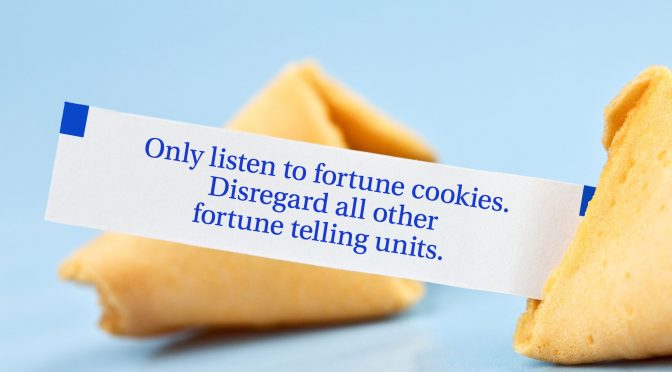
Fortune-Telling

A twin sister of mind-reading, who happens to be just as convincing in the least helpful ways is….

drum-roll!!!!!!

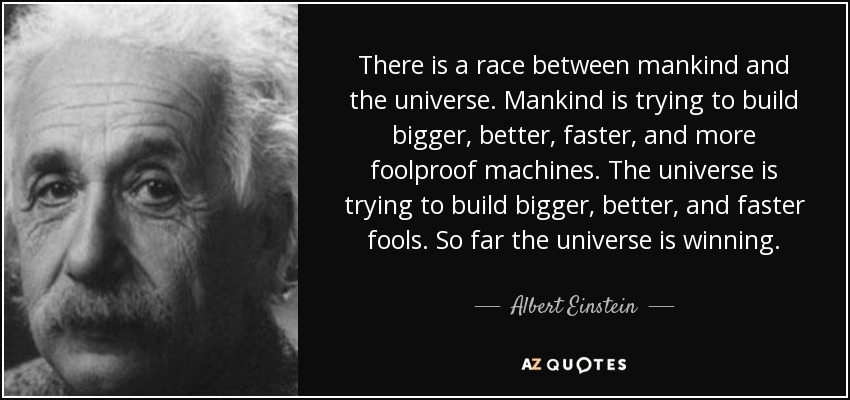
Albert Einstein, one of my favorite scientists said: “we cannot solve problems from the same thinking patterns we used in creating them.” This means, we cannot use the same patterns of thinking that manifested the problem to try and construct solutions that will actually work.

That is why it is so essential to become aware of these common cognitive distortions. Once we can develop a meta-cognition, of sorts, to observe the faulty patterns of cognition our minds may have developed over time, we can begin to solve deep-seated issues within our psyche.

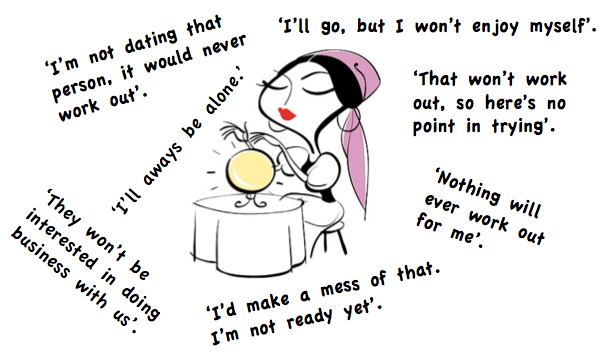
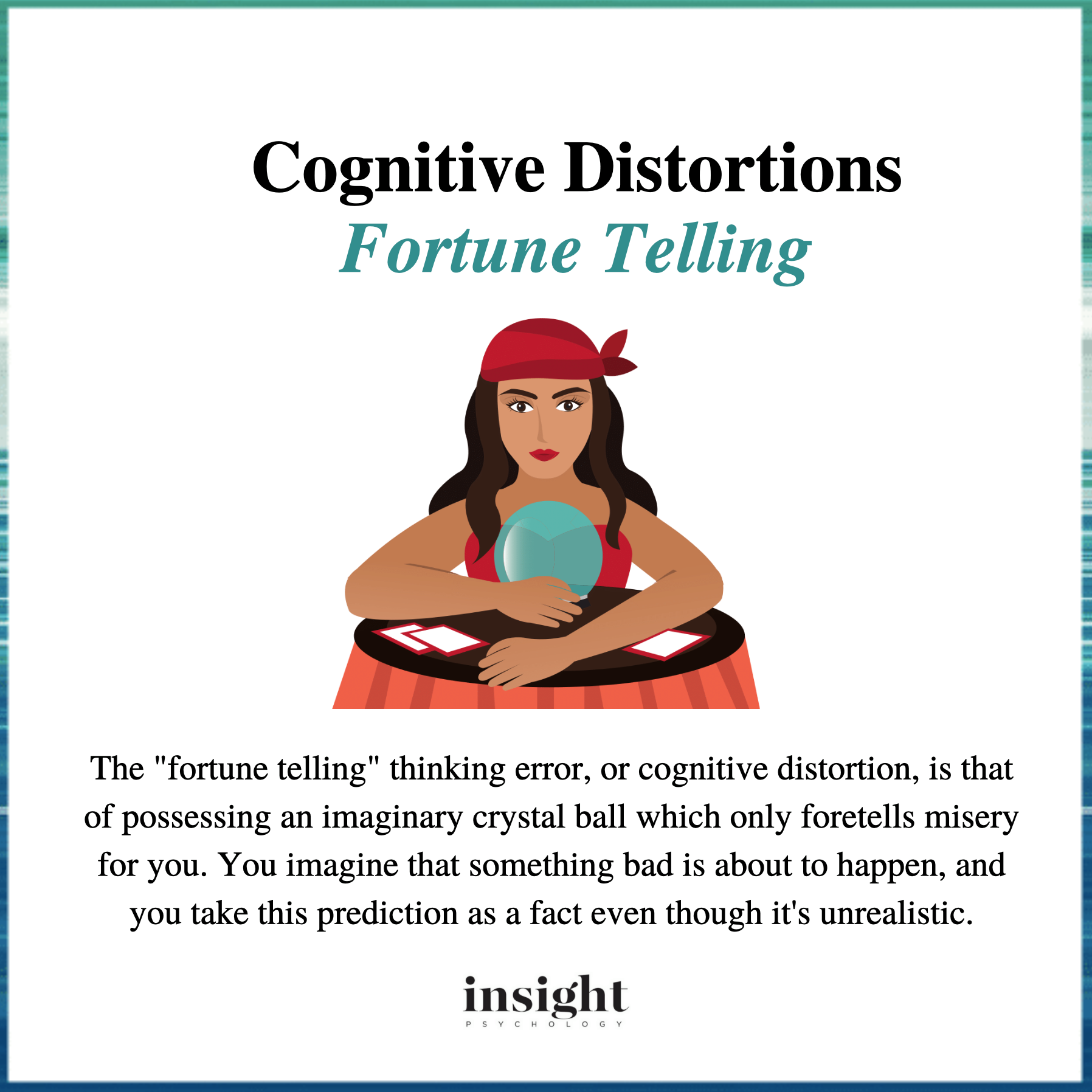
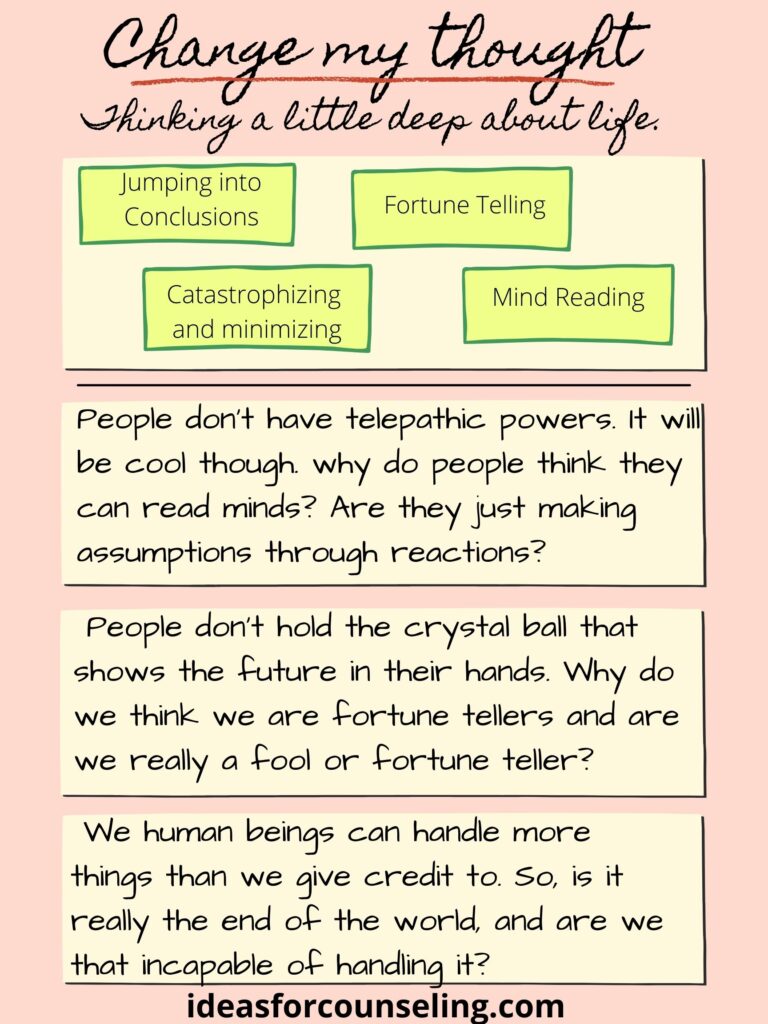
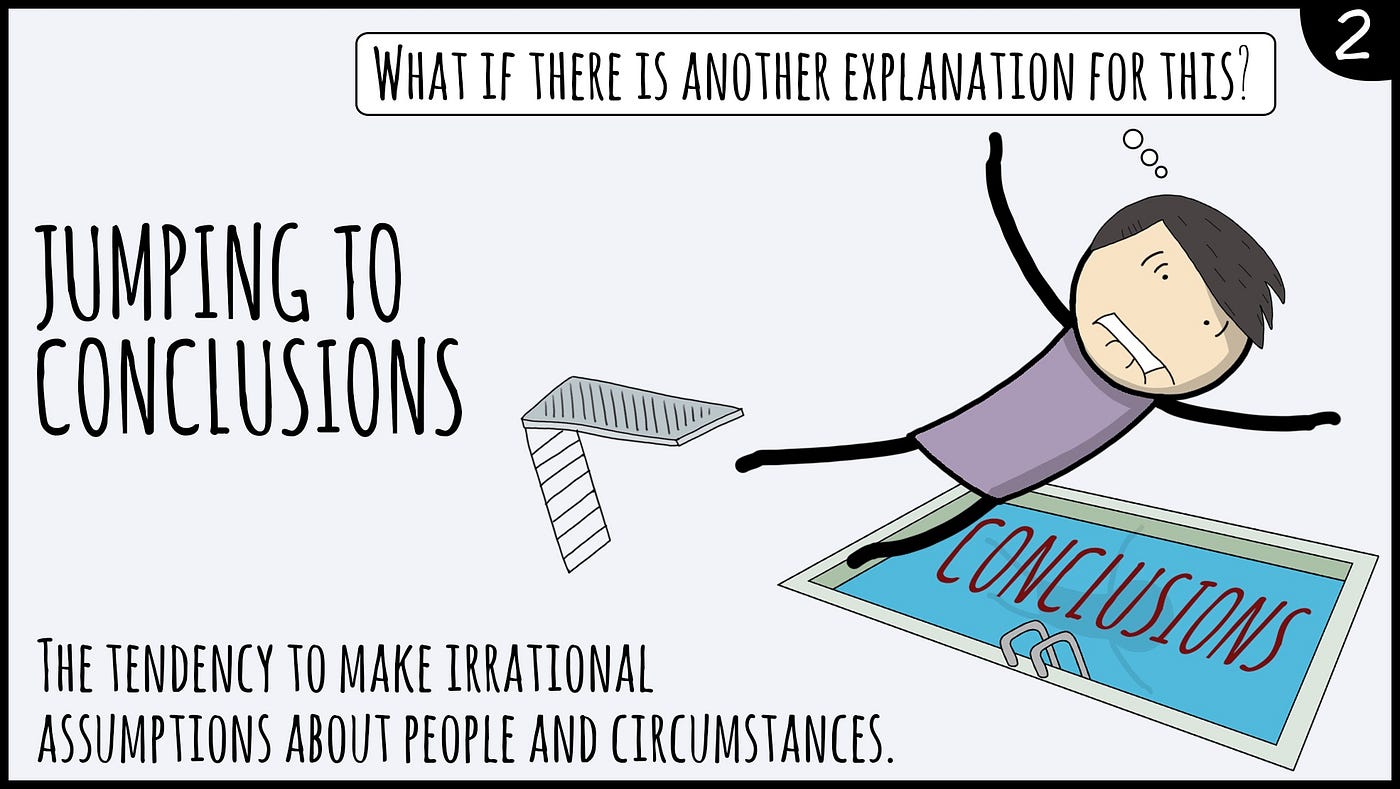
Fortune telling, much like mind-reading, is a branch in the family of cognitive distortions associated with jumping to conclusions. Fortune telling is a cognitive distortion that predisposes us to favor and predict a negative outcome without realistically considering the actual odds of that outcome.

This type of predilection towards worst-case scenarios is usually linked to anxiety and depression. Most often, those of us struggling through an active anxious or depressive episode display skewed thinking about the world and ourselves.

In fact, when I was practicing counseling in New Orleans, fortune telling was actually one of the most common cognitive distortions that came up for my clients. They seemed to have this eerie unbased “knowledge” that things would just end in a very catastrophic way without any real logical evidence to believe so.

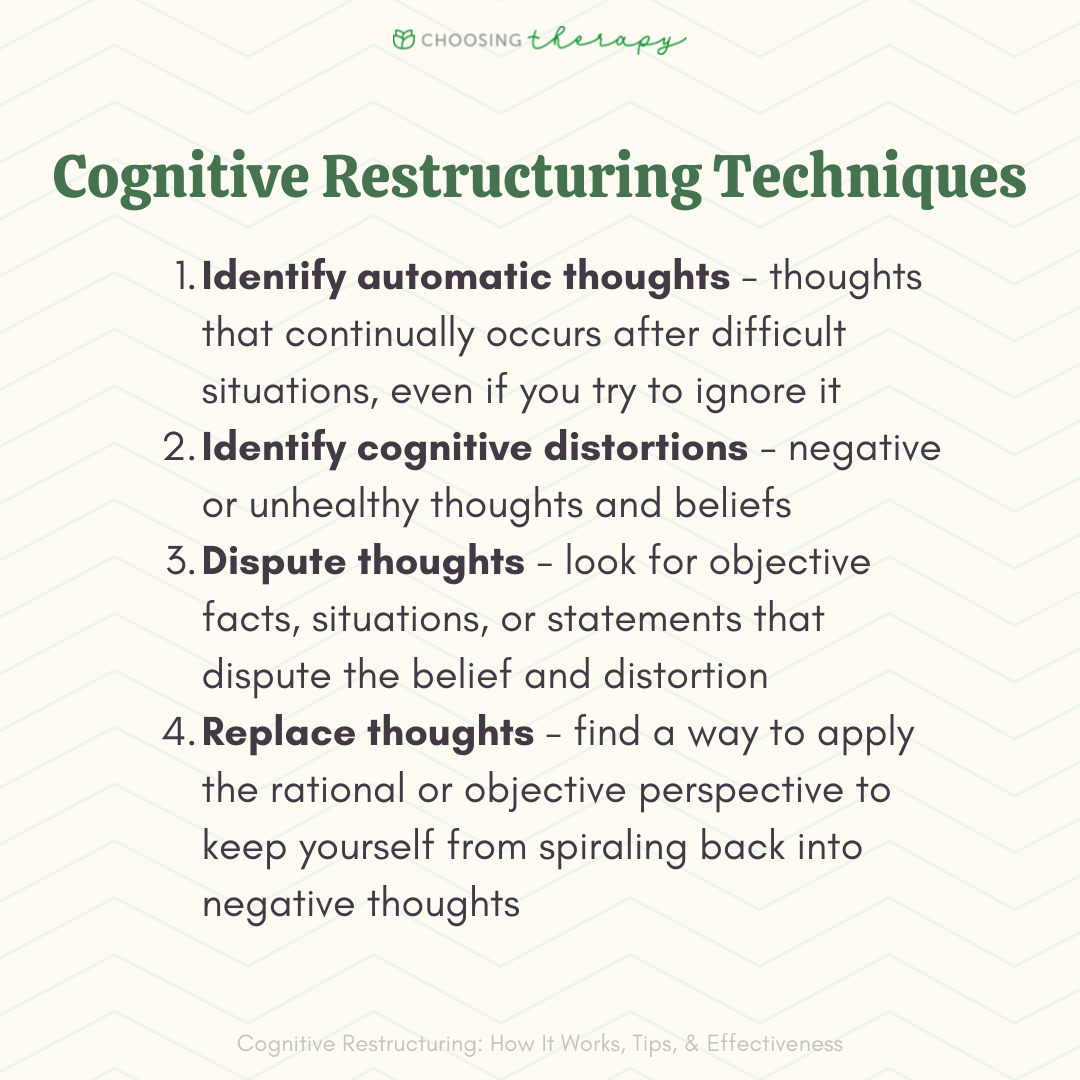
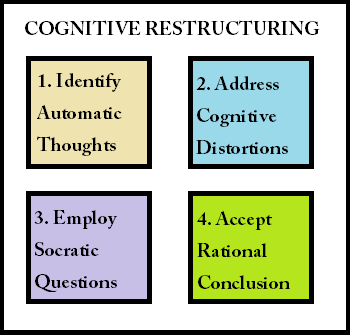
The process of taking some of these rehearsed faulty patterns of thinking and retraining the brain to replace them with helpful, more realistic and healthy patterns is called cognitive restructuring.

In psychology, especially among therapists that employ the CBT modality, cognitive restructuring is a technique used heavily to help individuals become aware of the age-old narratives they come in telling themselves. After appropriate reflection, clients are then challenged to analyze whether or not they would like to change their self-talk and automatic narratives. If clients decide that the benefits of change outweigh the price of staying the same, the therapist works directly with the client and helps reframe unhealthy automatic core beliefs to more helpful, healthy and productive ones. That is the goal of cognitive restructuring.

Our deepest beliefs, or cognitive schemas, are essentially the byproduct of a well-rehearsed story that we have knitted together through our own lifespan. Some of the meanings that we assign to our experiences are conscious, however, the process of forming our patterns of thinking are largely done by subconscious sources.

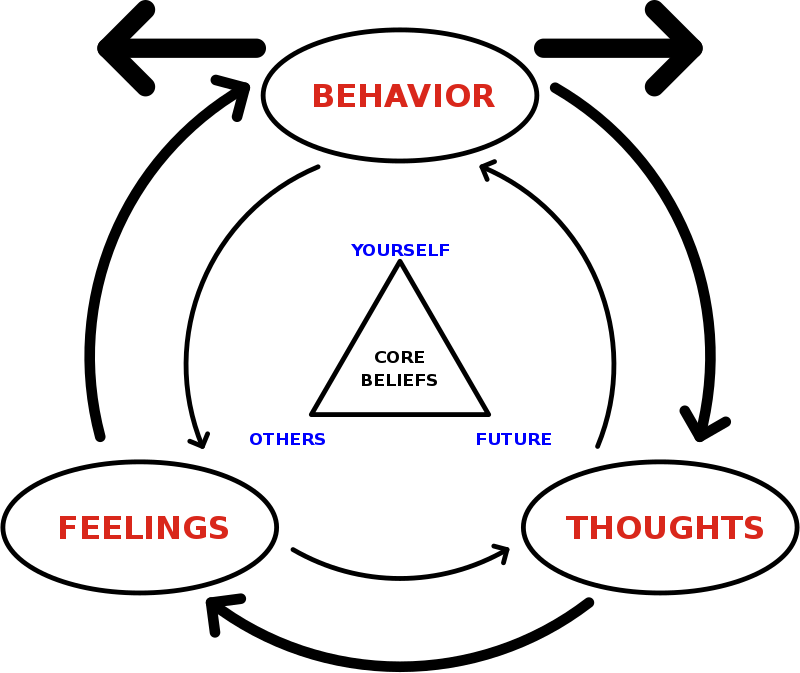
We see our beliefs reflected in our thoughts, feelings and actions. Our behaviors are the closest indicators of our true internal thermostat and core beliefs. The simplified medical way of looking at cognitive distortions is that once patterns are repeated, the brain simply learns an efficient, easier pathway of firing to arrive at a faster “action state”.

Here comes out the nerdy part of me! Something you may or may not know about me is that I pursued a double bachelors in Biological Sciences and Organic Chemistry in college. I graduated valedictorian of the college of sciences from College of Charleston with a summa cum laude. Studying the human body so closely sparked an interest within me to try to understand the mechanisms of the neuroplastic mind. That is precisely why I pursued my masters degree in Psychology and Counseling with a specialization in clinical mental health.

Anyway….

I want to quickly, and simply (hopefully) explain how our brains learn. The reason for this is because once we all are familiarized with the basics behind memory recollection, and how our brain creates meaning, we can begin to work WITH its natural wiring to develop more helpful patterns of thinking.

I view human beings as holistic creatures, and in no way would I ever advocate working against certain parts of ourselves. We are a unique collection of experiences, thoughts, behaviors, actions, cultures, and feelings. The more we understand each one of those compartments, the faster we can work with all facets of ourselves to improve overall life quality.

At every moment, our brain orchestrates a complex symphony of perfectly coordinated, and intentional signals across billions of neurons. These neurons, then, transmit the signals through trillions of synapses, lighting up pathways of the brain that are associated with a similar event (firing of dendrites). Becoming familiar with this complex neural circuitry enables us to start to understand the processes that work together to enable all aspects of brain function.

When we are learning something, neurons in different parts of the brain communicate with each other. If two neurons interact frequently enough, they form a connection that allows them to transmit messages more easily, efficiently and “accurately” (or so it thinks).

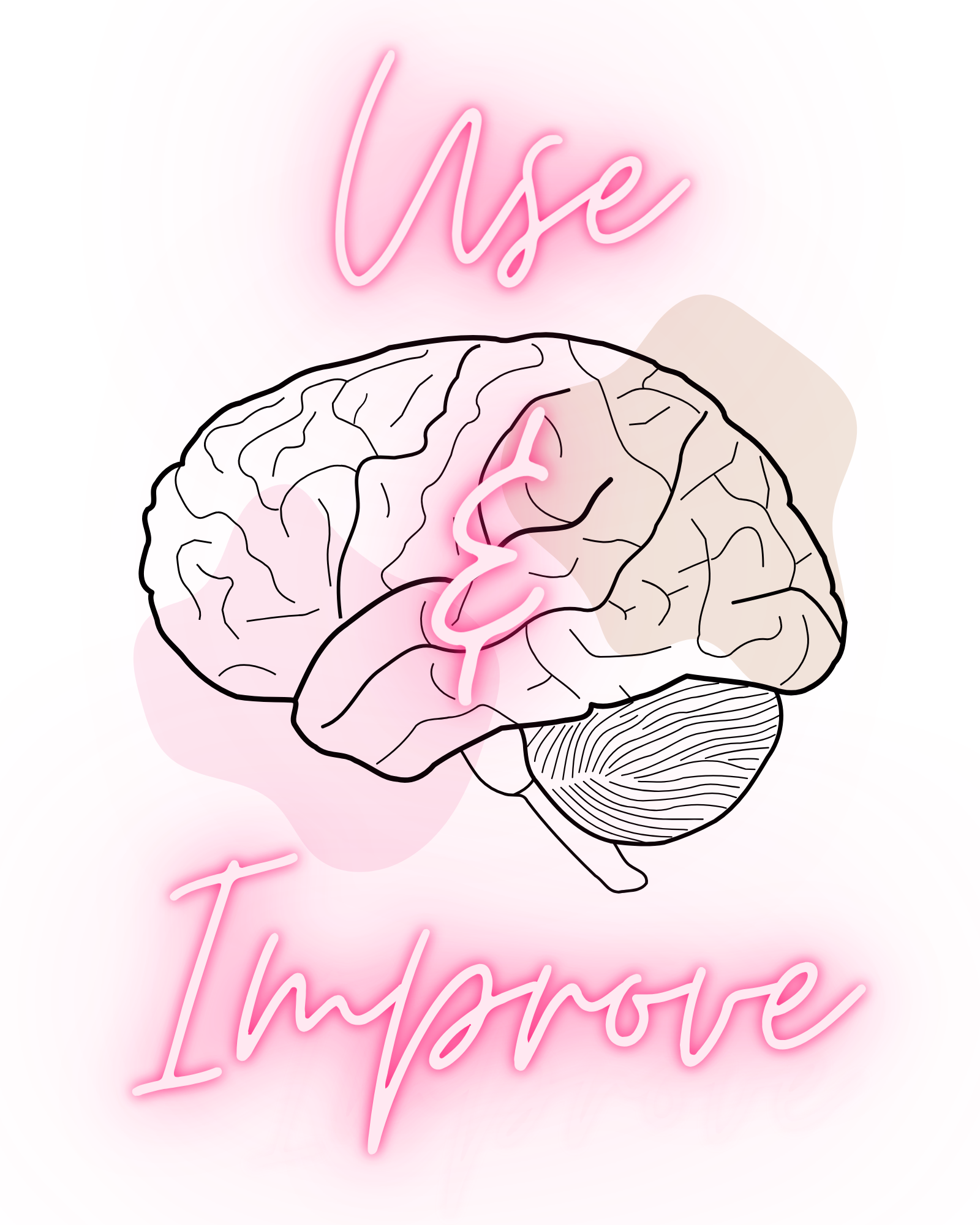
The more often certain neurons communicate with one another, the more fortified their connection gets. As a result, it becomes easier & easier for our automatic thoughts to follow in line with that same familiar thinking pattern. Use it and improve it!

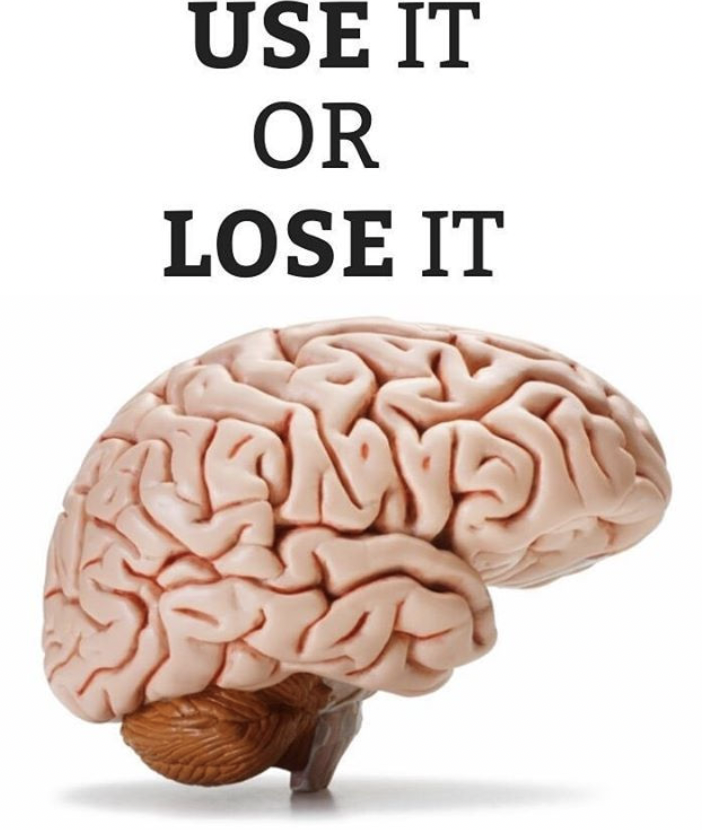
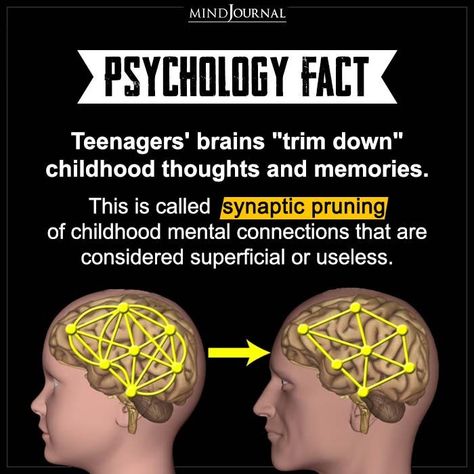
Similarly, the principle “use it or lose it” also holds true. Because there is such an infinitely overwhelming number of different pathways our brain cells can fire, most human beings tend to undergo a process of synaptic pruning. Essentially, “synaptic pruning” is just a fancy scientific way of saying “use it or lose it”

As we grow older, neural circuits that are not being actively engaged in performing tasks begin to degrade. Quite literally, this means if we do not use an area of our brain for a prolonged time, we will lose the function that was previously stored there.

The hope of so many psychological modalities lies in the neuroplasticity of the brain. Our saving grace lies in the fact that we can, with time and consistency, retrain our brains to think (and eventually, believe) differently. We have the power to wholly replace negative thought patterns with positive ones–literally, changing the very wiring of our brains.

That is some pretty powerful stuff.

If we have learned it, we can unlearn it.

Furthermore, we can also learn something else–something entirely new—something more conducive to our well being.

This is where cognitive restructuring can literally change our lives (if we let it).

Much like everything else, it takes a lot of practice and it takes times. Therefore, it is important to be gentle with ourselves throughout the process of rewiring our thinking. We didn’t just “think” ourselves into who we are overnight. By that same token, we cannot “outthink” ourselves into somebody new overnight either.

Tip #1- Challenge your thoughts by asking very basic, simple questions.

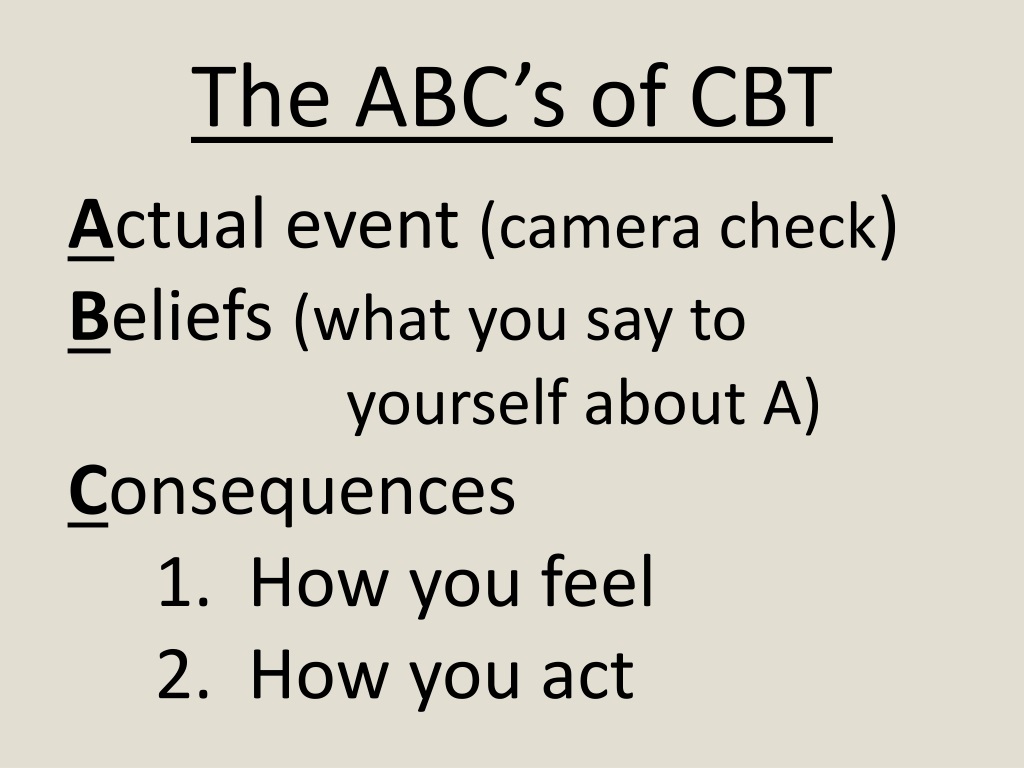
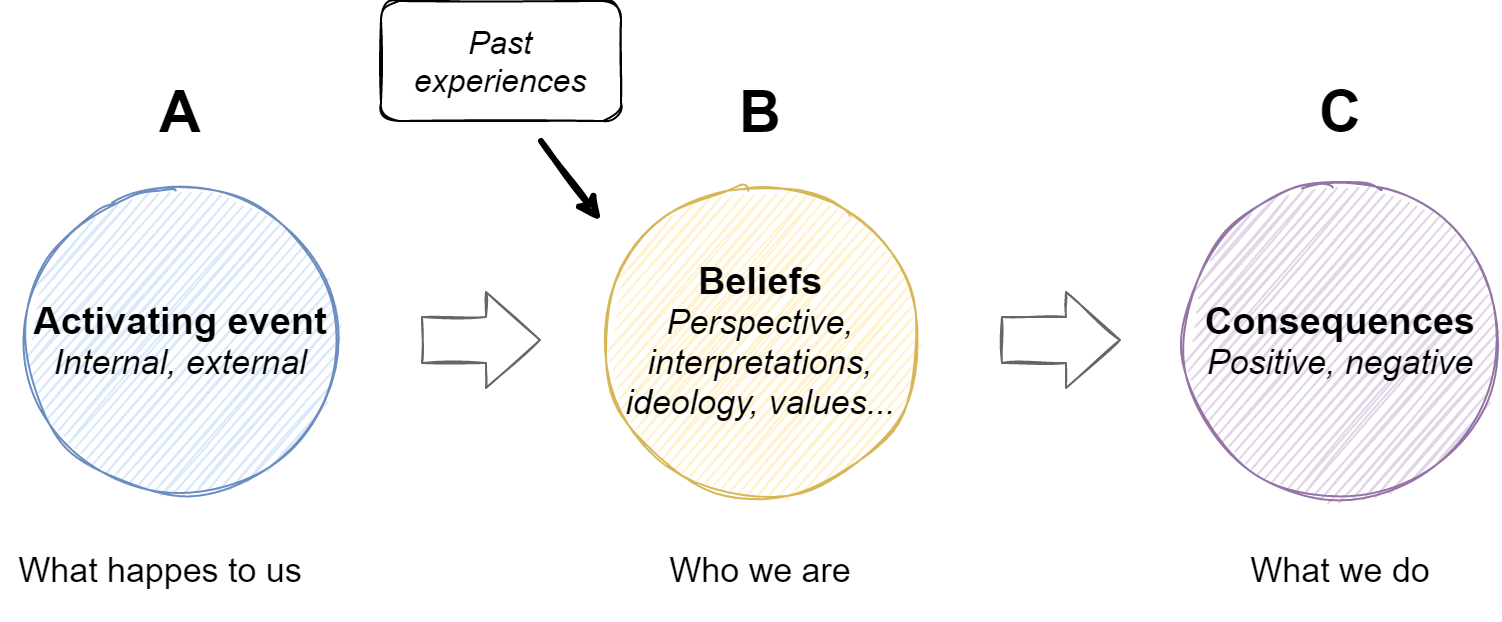
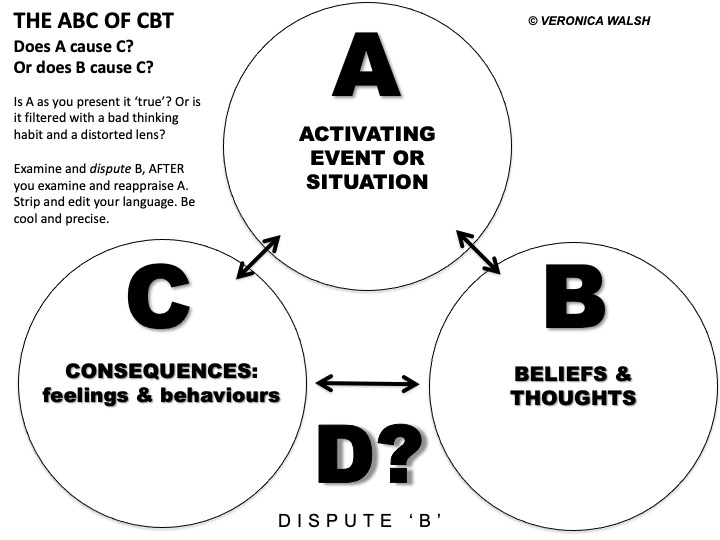
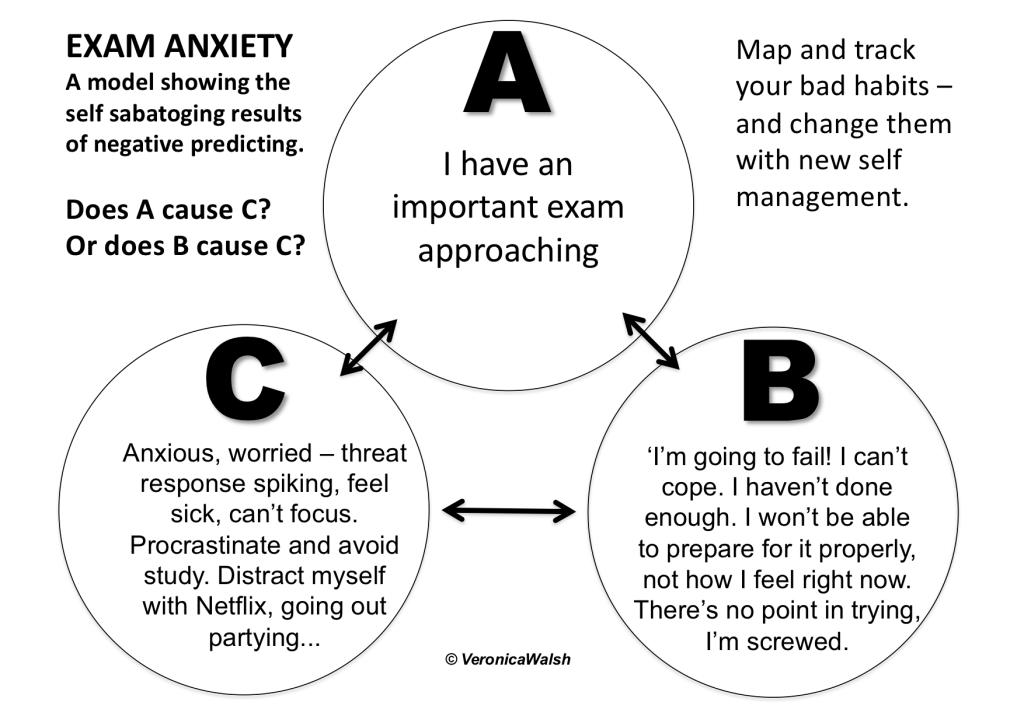
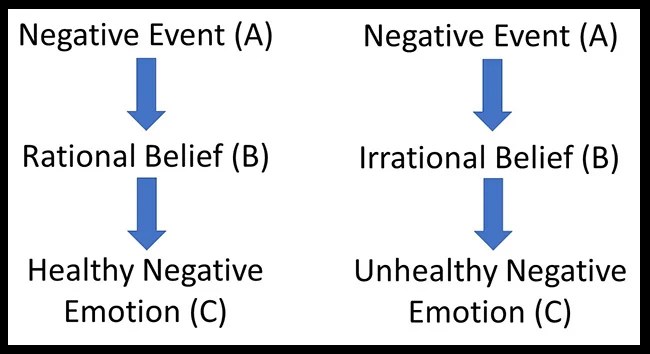
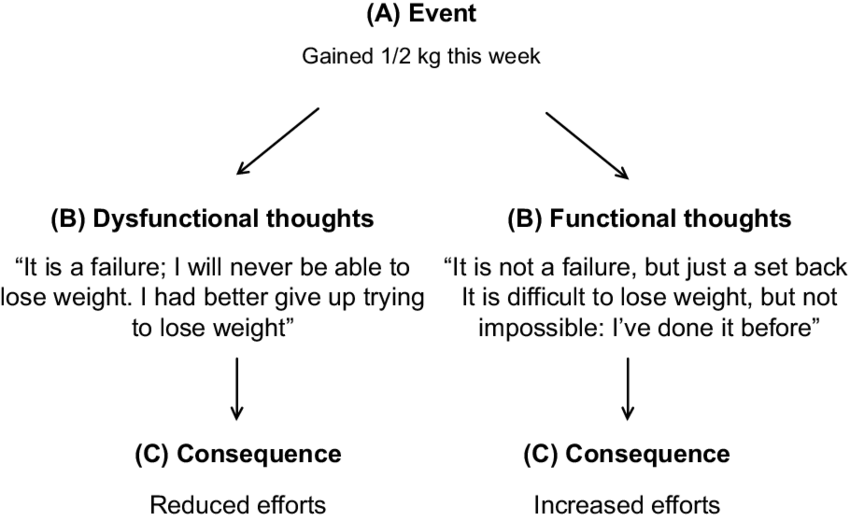
Tip #2- Use the ABC model to help slow down and track thoughts so that we can begin to change them.

What is an “ABC” Model?

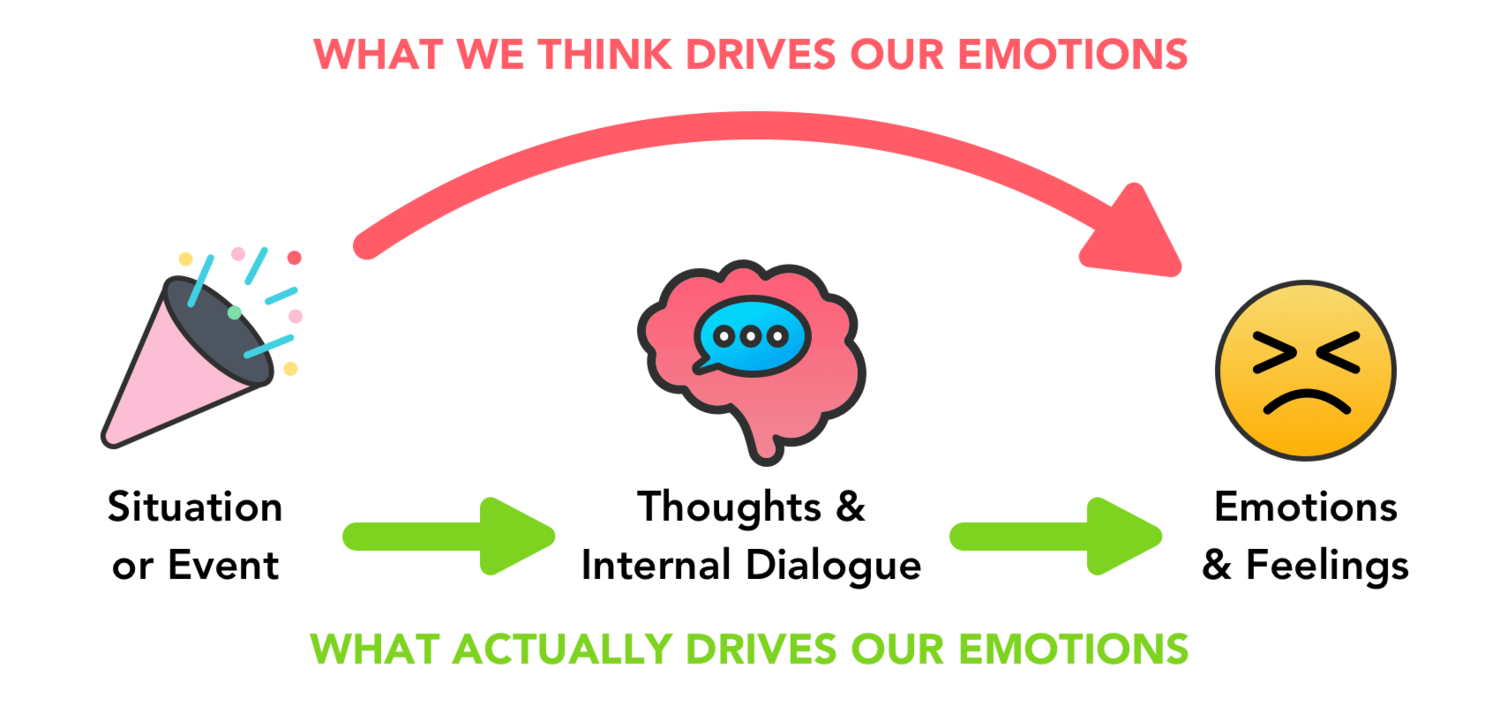
The goal of conducting the ABC analysis is to truly get to our core beliefs that trigger our thoughts and feelings. Once we target what our core beliefs are, we can analyze them and figure out if they are based in reality and if they are helpful to us or not.

ABC models are most helpful when done on paper. There is something about writing things down that allows our brain to slow down processing and truly pause.

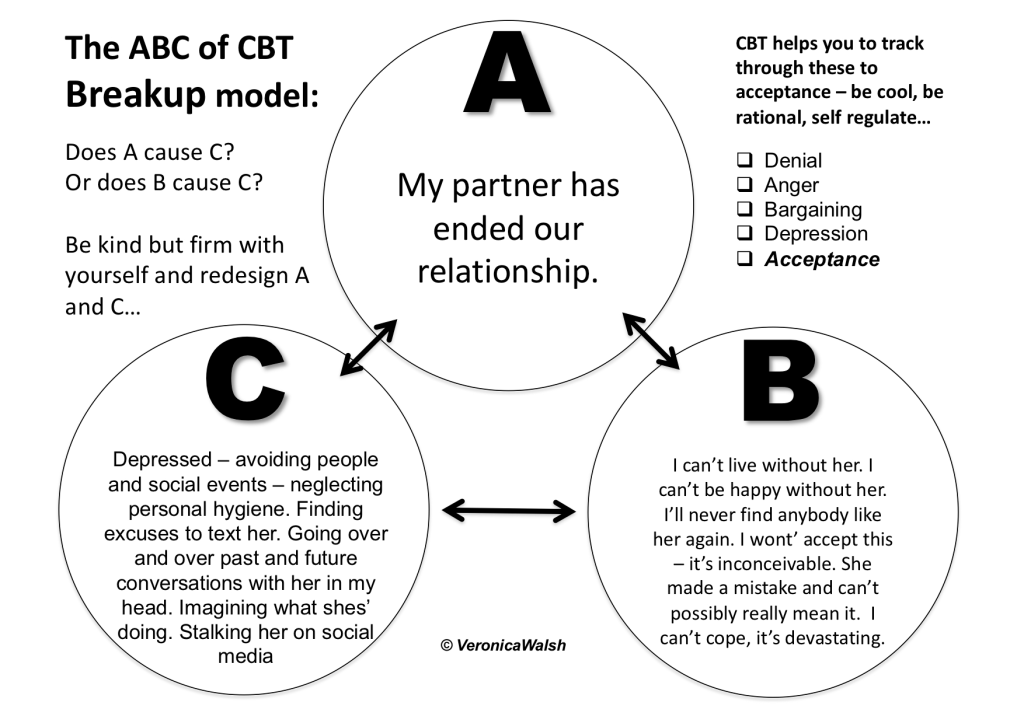
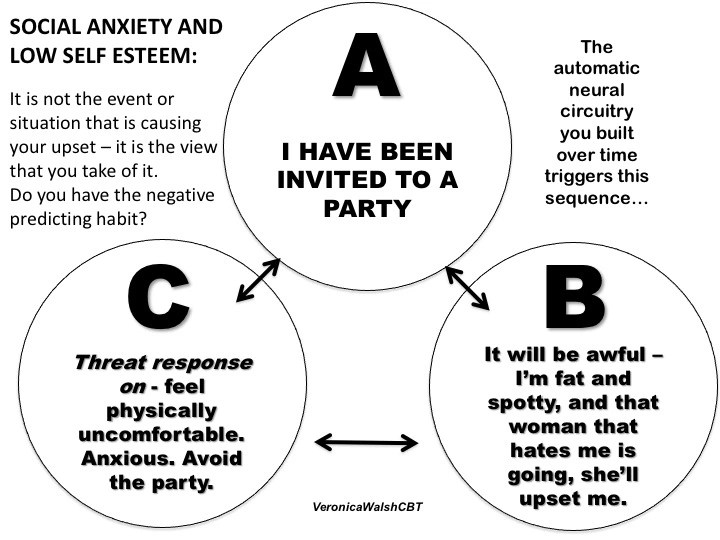
Examples of ABC models that have been done

Example 1: End of Relationship

Example 2: Social Anxiety

Example 3: Performance Anxiety

Tip #3- Use a “Behavior Chain Analysis” to monitor new and old behavior

The basic set-up for a chain analysis is as follows:

I encouraged all my clients to do at least two behavioral chain analyses. The first one should depict what would (continue to) happen in each of the categories if the core belief was left unchanged. The second one should ideally depict what would change in the respective categories if the core belief were to be challenged.

Example of Behavioral Chain Analysis utilized in CBT

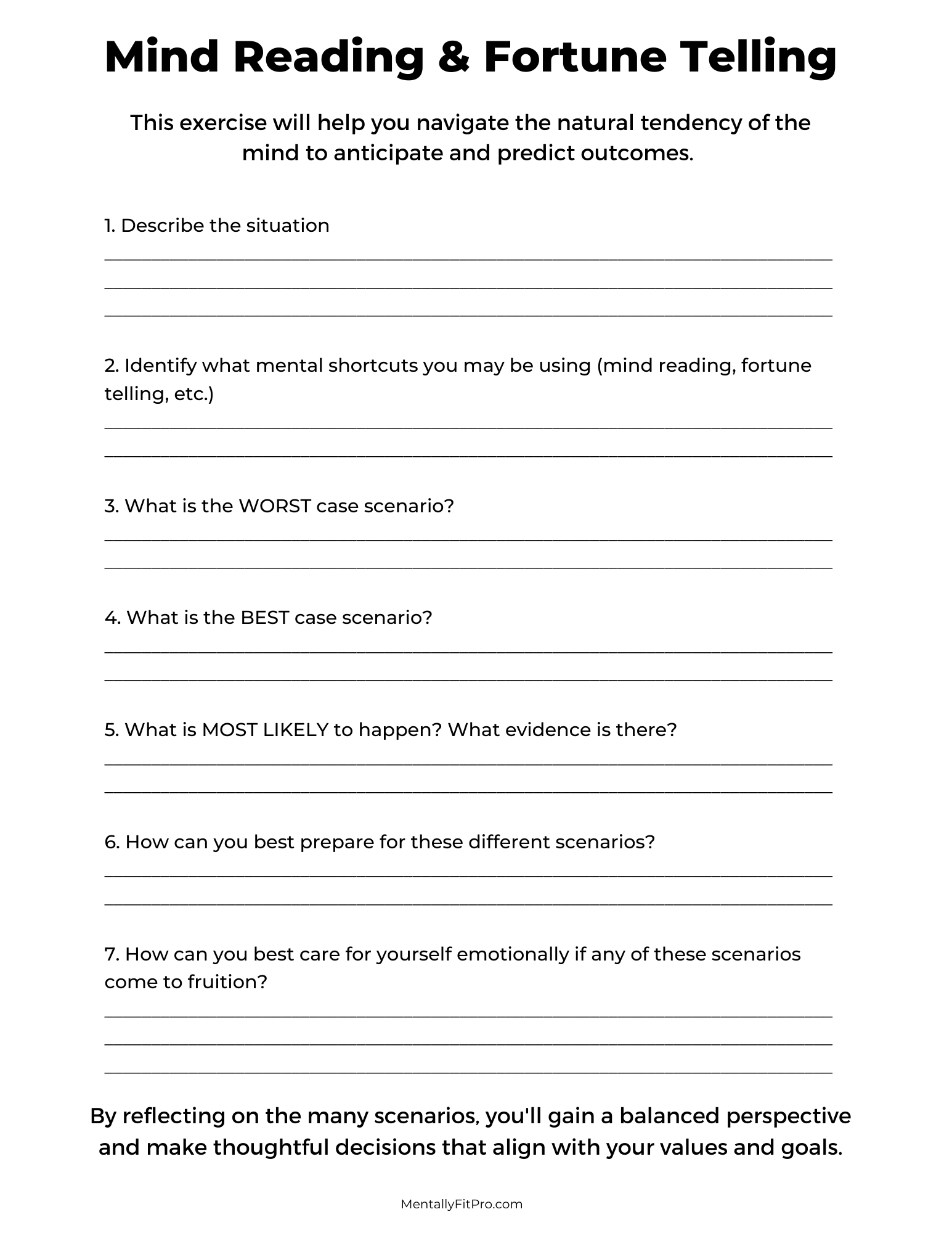
Tip #4- (If you really want to do some serious cognitive “soul searching)…try some DBT or CBT worksheets that help prompt you to examine your core beliefs.

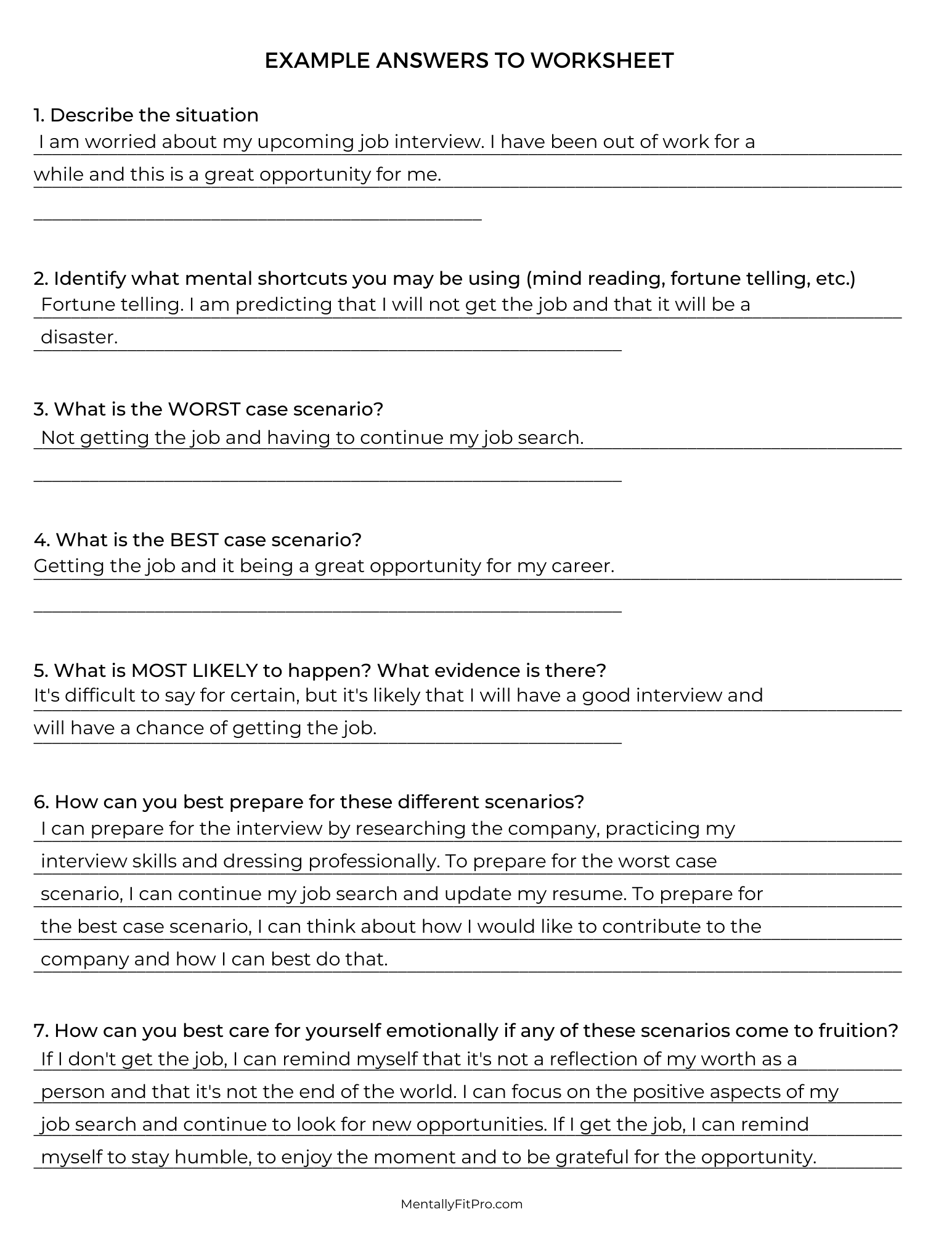
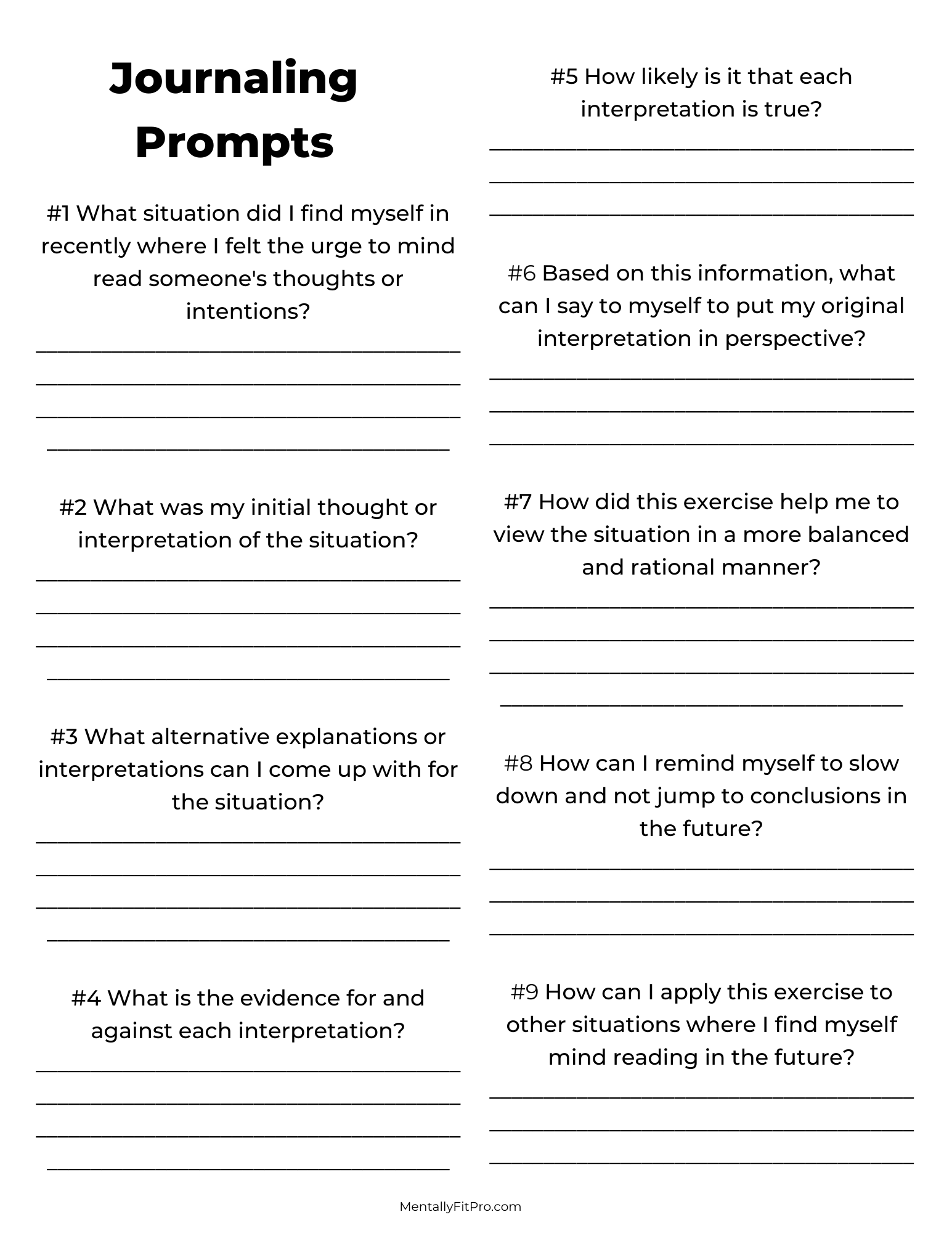
For our purposes, I am going to upload a copy of worksheet that I have used and given others to use when I find myself jumping to conclusions, engaging in mind-reading or becoming my own self-anointed fortune teller.

Page 1

Page 2

Until next time ❤

Try to avoid getting caught in stinkin thinkin!

Love you, all ways, always.

2024 is going to suck.

This week, we will be returning to one of our mind’s most revered, well-rehearsed, and absolutely maladaptive ways of thinking, or what were they called again???

COGNTIVE DISTORTIONS!

Distortion, who?

WARRRRRRRRRPPPPPPPPPPPPPP

Cognitive distortions are unhelpful ways of thinking that are adopted throughout the lifespan of a human. They are usually adopted as defense mechanisms in immediate acute stages. However, if they continue to linger on and become a part of our daily routines, they become highly problematic. All cognitive distortions are patterns of thinking that are usually cultivated during a crisis–a short-term response to an emotionally overcharged situation. They are not inherently “good” or “bad.” They are just mere momentary defense mechanisms to help us get through immediate tension. When they become more overarching in our lives, they begin to infiltrate our day-to-day life and cripple our interpersonal connections and self-evaluation.

This week, WE will discuss one of the triplets of a a family of cognitive distortions.

The FATHER of this family is jumping to conclusions.


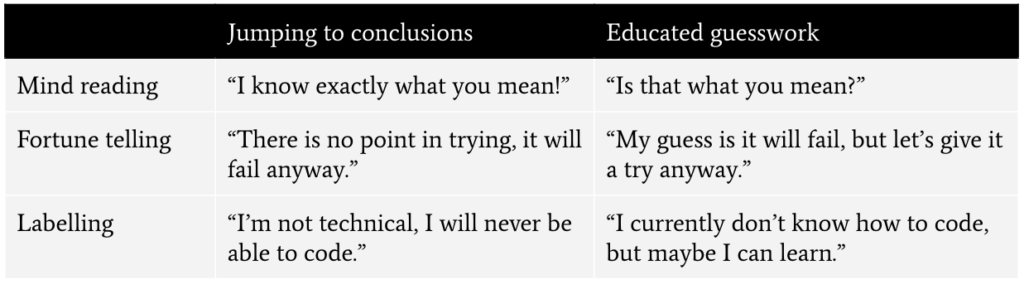
In psychology, this distortion branches out into three categories:
1. Mind-reading
2. Fortune-telling
3. Labeling.

So…what does each one pertain? Why do we engage in these negative ways of thinking? Most importantly,how do we catch ourselves in the midst of it so we can begin to stop it?

Here is your one-step stop for nipping these types of unhelpful patterns of thinking in the bud.

Mind-Reading

The first mutation branching off the “jumping conclusions” band wagon is “mind-reading”.

So mind-reading– What is it? When does it become unhealthy?

I think it’s really important to get the crisp, curt definition of the phenomenon.

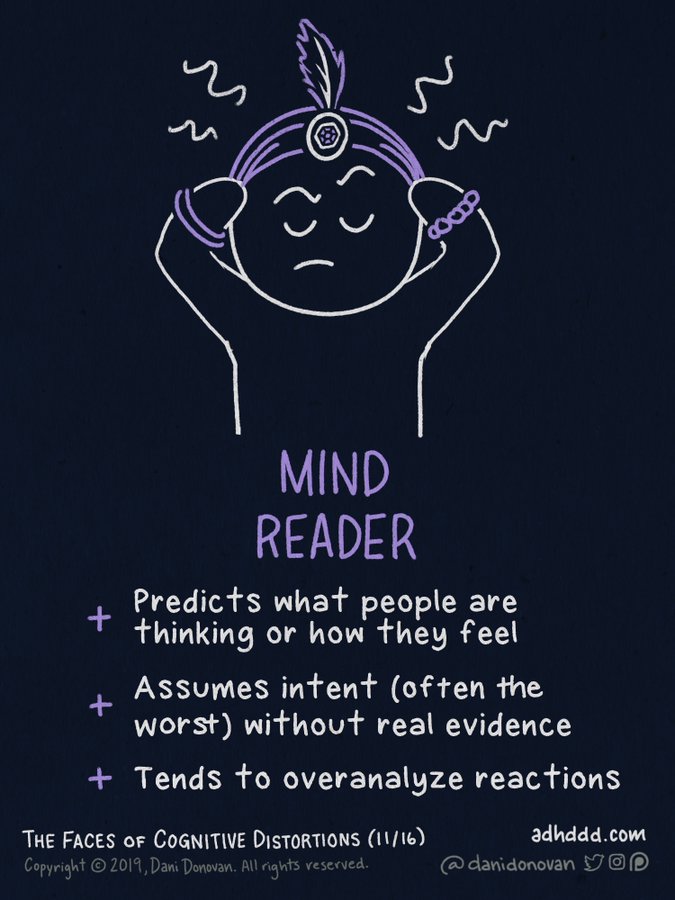
In general, “mind-reading” refers to the super-human ability to discern the thoughts of each other without the normal means of communication, especially by means of a preternatural power.

In psychology, “mind-reading” falls into a subcategory of one of the most common cognitive distortions; its corresponding parent category is “jumping to conclusions.”

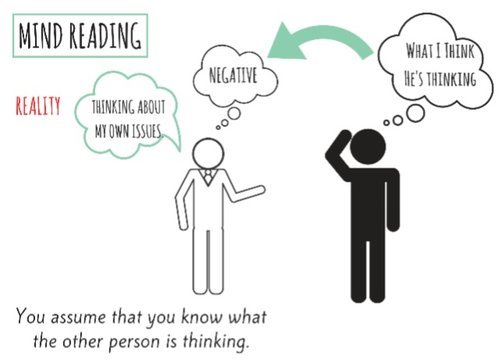
Mind-reading is a misnomer given to the cognitive error that occurs when we try to predict what someone else is feeling based on our own assessments of the situation alone.

Just in case you were curious, the conclusions we arrive to through mind-reading are usually WRONG.

When we are engaged in mind-reading, we do not take time to consider others’ unique thoughts and life experiences, and we become increasingly and incorrectly stuck in our limited lens of thinking.

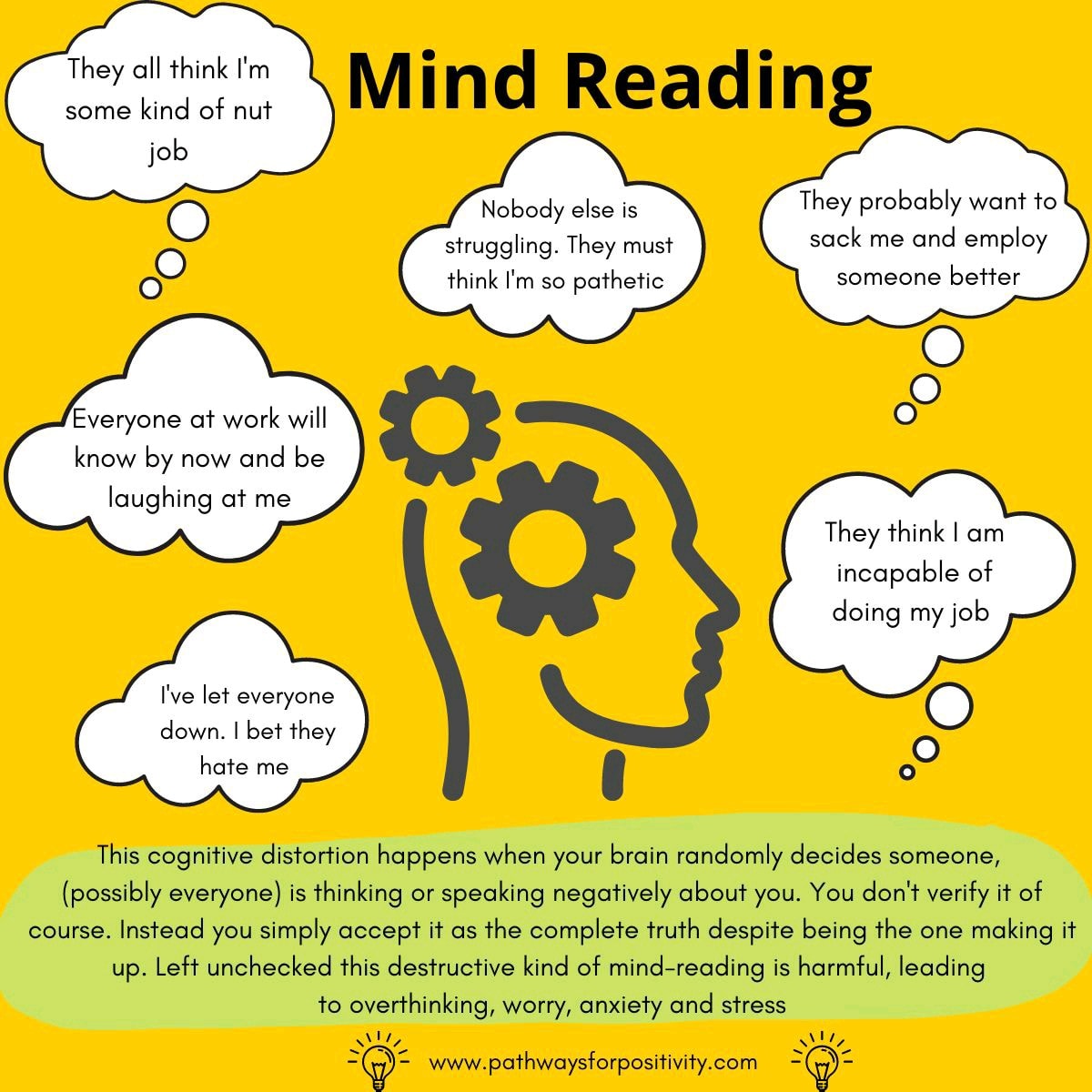
Some examples of “mind reading” look like:

As you can see, those are some lofty assumptions about reality. Another poignant observation is that each thought bubble shares the same faulty pattern of thinking. Each of these situations involves a person incorrectly assuming something to be true for another person. The problem with this type of thinking is that we are usually projecting what we feel onto others. We usually do not take time to check our facts, and consult with the other person/people in situation to see if our “read” on the situation may been skewed.

The truth of the matter is NO psychologically sound person is capable of “mind-reading.” It simply does not exist. In fact, if someone were to tell me that they knew, without a reasonable doubt, that another person was feeling a certain way, I may have to recommend them more intensive psychiatric help.

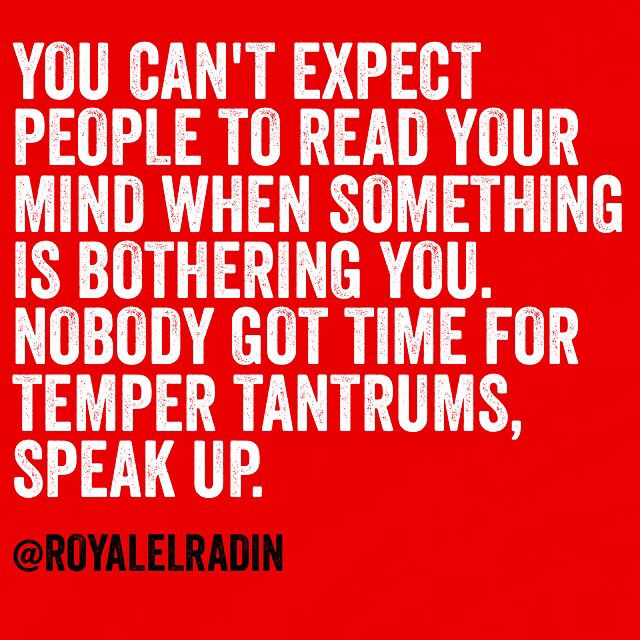
Believing that we know what others need, want, and think without communication is a delusion. We do not truly know what another wants or needs are unless there is an appropriate exchange of questions and answers.

That is why some of the most helpful skills therapists try to coach their clients are in regards to communication. We must questions for clarifying because, who knew? We are not always right.

By asking others how they feel, or what they want, we allow them to exercise their birthright of autonomy. When we ask questions, we create space for others to clarify their desires, thoughts, and actions.

I find myself commonly engaging in mind-reading around people in my immediate circle. It is only natural to study, observe and gather nonverbal data on those that we spend the most amount of time with.

The problem with this natural predilection is that our mind cannot stop doing it. So much so that, it sometimes does its job too well. It will arduously collect information, day in and day out. Now, the brain is not to blame. It is only doing what it was created to do. The primitive brain is often trying to categorize only in an attempt to simplify complex human realities. As a result, we may jump to conclusions, polarized thinking, overgeneralization and other patterns of erroneous thinking.

An Example of how F*CKED up it can get FAST

We have all experienced being the friend/coworker/partner who finds themselves thinking: “Oh no! ______ hates me. I’m just sure of it!” (of course we are)

This type of charged thought usually infects our brains long and before we know it, the parasite has taken over our secondary thinking. All of a sudden we are dealing with a cascade of negative feedback.

Quickly after suggesting the notion of someone not liking us to the brain, we begin to subconsciously “collect evidence” to support that same incorrect belief.

For example, if that person looks up and frowns, we are more likely to assume that it is because of their loathing towards us rather than a completely unrelated cause.

As more and more time goes on, the narrative in our heads thickens until we start to notice every single sigh, eye roll, and sarcastic remark and internalize it towards us.

We become so zoomed in; in this highly charged state, we become acutely aware of the slightest changes in the other’s body posture. Our panicked brains’ engulf themselves in rapidly computing every nonverbal cue to become negatively-connotated; we are trying collect all the (already-biased) information so that we may somehow arrive at the “logical” conclusion. At least, that is what the brain will have us “believe.” The truth is exactly what I stated above–we cannot ignore our own inherent bias about the situation.

The way our brains are wired is literally to search specifically for proof that validates the ideas we already believe to be true. We think we may be neutral, but at best, through psychoeducation and self-awareness, we can become mindful of the preexistence of these unique, acquired biases and shortcomings we have.

Next week, we will be delving into an equally insidious twin sister of mind-reading, who seemed to have gotten her dysfunctionality gene from their shared father–jumping to conclusions.

But before, let me not abandon you without suggestions for how to survive the tendency to mind-read.

Tip #1- Reflect and Retrain

The most wonderful and liberating thing about realizing that we are, most likely, wrong….is that we also possess the power to re-equilibrate our thinking to align more closely with reality.

I want you to ask yourself the following question

Why do I assume that people will treat or talk about me in a bad way?

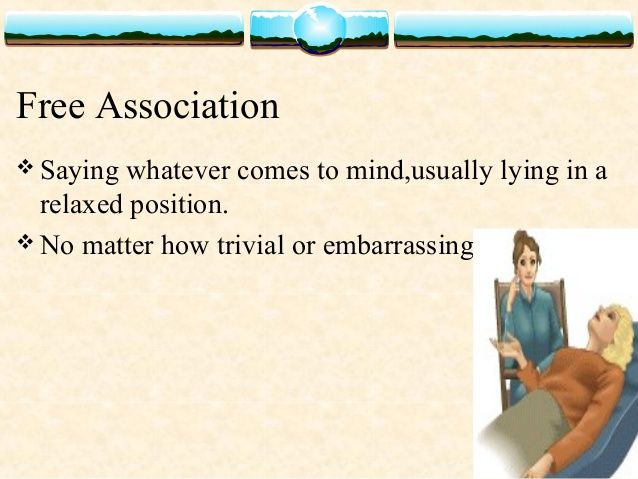
Please write down at least 10 reasons why you believe that to be the case. The best way to approach this exercise is to a) don’t judge yourself too much for believing it because we all do. We all seem to think that the world is preoccupied with us, to some extent. I want you to try to “free-associate” when jotting down the answers to the aforementioned question.

What does free-association mean?

That means, it does not matter how ridiculous, narcissistic, self-absorbed, negative or absolutely ludicrous your brain’s responses are to that question. I want you to just jot them down, without thinking (well…while minimally thinking). The point is to gather your automatic thoughts so that we can focalize on the underlying belief that may be driving you to think that you are indeed, the center of the world, and the reincarnation of the antichrist.

Tip #2- Observe Your Reaction During Mind-Reading

Mind-reading causes negative symptoms in your body and accelerates the fear which already exists. The reason we ALL begin to mind-read is because some external trigger has literally inflamed a pre-existing insecurity we had long before someone else ever rolled their eyes around us.

If you get anything out of this post—or anything out of the series of posts about cognitive distortions–please let it be this: WE MIND-READ BECAUSE OF WHAT WE BELIEVE ABOUT OURSELVES. It happens because someone or something else has triggered something that already PRE-EXISTED (usually long before) the irritant manifested itself.

As a result, our bodies start to give these tell-tale signs that we often ignore because we jump to conclusions and become extremely preoccupied with protecting ourselves. It is so vital to slow ourselves in the moment to observe these bodily sensations and cues because they can be of utmost help in recognizing our tipping off balance.

For example, fear of inadequacy is a phobia that often triggers me to mind-read. Due to my life experiences, and my own interpretations of them at the time, I have a very hard time controlling my reactions and thinking when I even SUSPECT that someone has “figured me out.” The following is an example of how my brain works:

– Insert external trigger: an eye roll or sigh or someone not saying hi to me.

Omg! ______ saw me and ignored me. What did I do? Is it because I didn’t say hi to her? Did I look mean? Did she overhear her me saying something negative about her? Should I apologize? I’m such a failure! I knew it. Everyone in my life was right (overgeneralization). I have been figured it out. God damn it! I try so hard to perfect this “facade” of having it all together and I knew it was just a matter of time. They’ve all figured it out. She’s probably told everyone else that I’m just a big old imposter. A wannabe. A loser. Someone who tries so hard just to “help” others because they just want to feel good about themselves. And you know why? Because I suck. I suck. and I KNOW I SUCK (emotional reasoning) and there is no way for me to hide it. It will always come out in time….etc.

The above was an example of free-association. Do you see how fast my thoughts spiraled?

Now, what is likely is that before I stepped into the quicksand of my dendrites firing away, there were probably tons of sensory cues that warned me that my brain was about to go down this path.

I know I must have felt that “heart drop” feeling. I don’t know how else to describe it, however, I know I ALWAYS tend to feel it when I feel rejected, humiliated, or fearful. It’s that pang in the heart. I might:

  • Start flushing red
  • Feel my body temperature rise
  • Start shaking
  • Show patterns of uneven breathing
  • Tighten up my shoulders due to tension
  • Begin to feel my stomach churn due to feeling uncomfortable.
  • Feel like I need to puke
  • Become clammy
  • Start furrowing my brows in worry
  • Feel “frozen” in time
  • Feel my heart beating faster.

There are so many different ways that our body tries to catch up to our mind. Even though each one of our “tell-tales” may be unique and different, I promise you that they exist. We all must work towards becoming aware of them so that we can not fall down the rabbit hole I just described above.

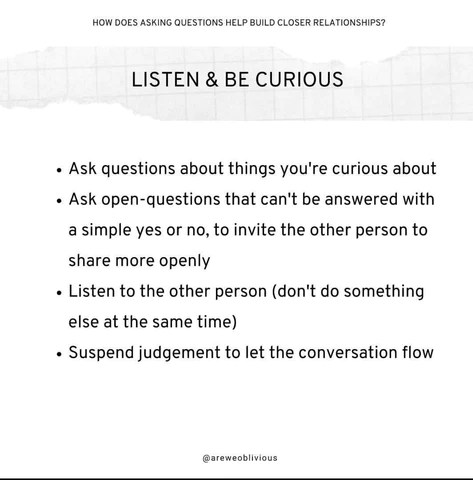
Tip #3- Ask questions

This is the simplest and most efficient way to nip mind-reading and other cognitive distortions in the bud. It is also one of the most difficult ones, in terms of mustering up enough bravery to ask something we may not want to hear the response to. I have had to train myself, and even come up with “scripts” when I’m not heated, that I can use in the moment to help clarify what I’m thinking. Some include:

  • “Hey, this might just be me, but I feel like there is a shift in energy in the room/between us (etc). Did I do something to offend you or upset you?”
  • “Are you upset with me, or is it just me?”
  • Bonus tip: ADD HUMOR– “You know my tendency to think everything is about me…so I saw you sigh earlier, and automatically jumped to the conclusion that it was indeed because of me. Now, I know I’m probably overthinking this, but I wanted to clarify and give you the opportunity to remind me that I’m just not that important.” this one gets a lot of laughs.
  • “I keep feeling like something is off with us. Am I wrong?”
  • “Hey, are you okay?”

Asking questions allows us to tell on ourselves, and allow others the autonomy to express their own feelings. Furthermore, it opens up the door for us to become of service to those around us if there is something unrelated bothering them. Checking in with others and being transparent about our own tendencies to catastrophize can also help them find us more relatable and feel comfortable enough to talk to us if there is something wrong in the future.

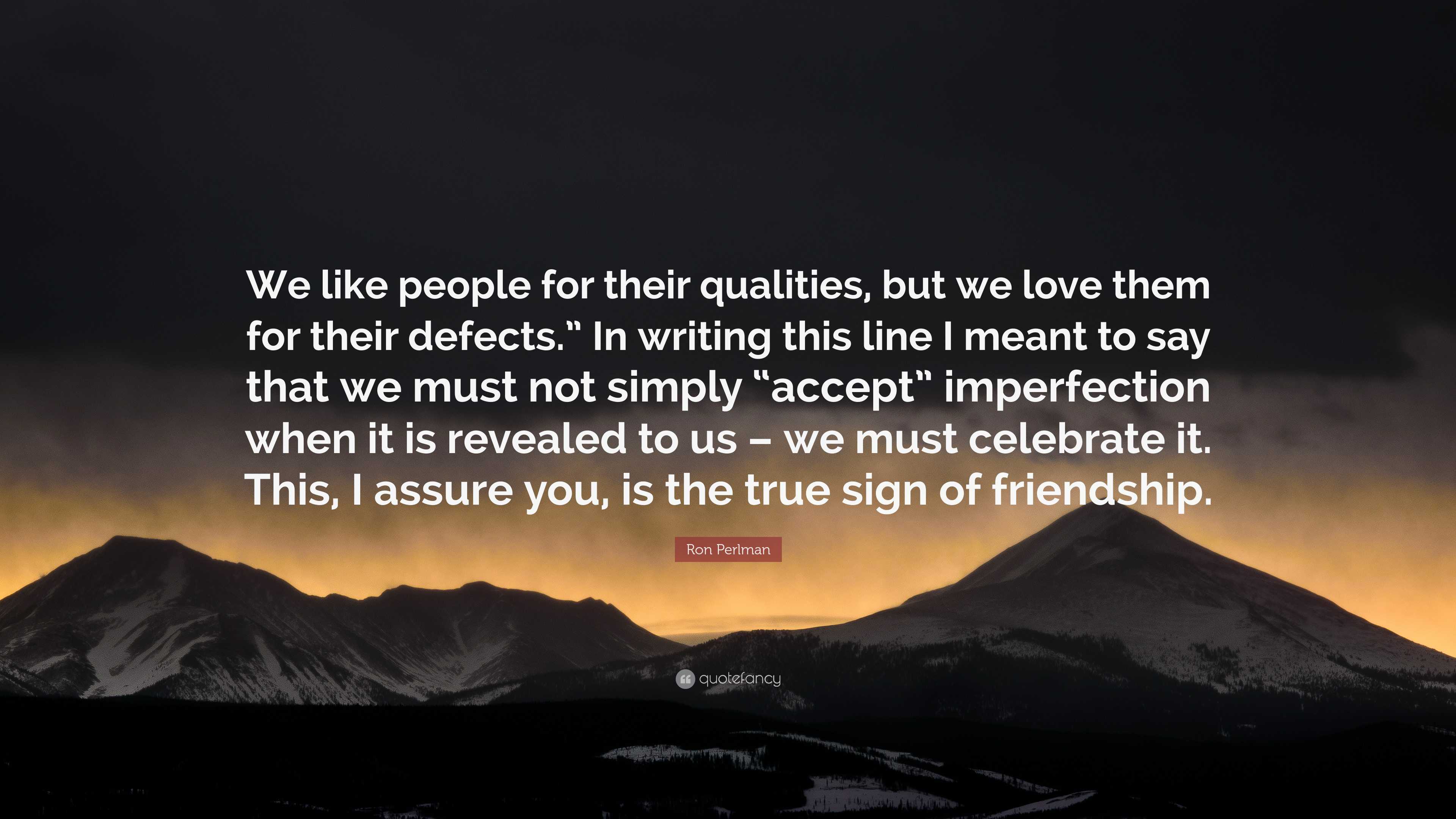
Please re-read this as many times as you need: “we LIKE people for their qualities, but we end up falling in LOVE with them for (admitting) their defects”.

Love you, all ways, always ❤

Till next time,

My biggest FEAR

Life is unpredictable.

sisters7

I had planned for this post to be about foam-rolling, and though that will be coming soon, it will not be coming today. As I sat down to write this blog post, I found that my heart was somewhere else. So, I decided to loosely follow the direction of my heart, as writing about anything that is not my raw, unfiltered experience would be a disservice to both you and I.

Today, I want to talk about nothingness.

Wonderful-White-Rose-With-Pearls-In-Water-Wallpaper

I have a really hard time being still. And no, I promise its not because I have attention deficit disorder. My fear resides in a more philosophical dwelling. The fear of “being” has plagued me for as long as I can remember. As a child, most of my nightmares consisted of not doing anything. And not doing anything consisted of not being “seen”, heard, or noticed. If others did not notice me, would I even exist? Furthermore, if I ceased to exist, what would I be? Would I be nothing?

To this day, my mind responds with silence.

And, I’m fearful of its silence too.

As a result, I have found safety and comfort in “doing.” Whether it’s going to school, maintaining activity at the gym, or simply attempting to keep up with the springing dynamic thoughts in my mind, I am always moving.

Screenshot_2014-07-26-04-03-02-1

 I have built a tenuous home in chaotic motion. I suppose, “doing” something all the time grants me some degree of disillusionment from my deepest and darkest fears; mobility serves as a relieving distraction from my ultimate fear of being still. Upon reflection, I suppose that I have equated “being” with nothingness. I am not exactly sure how, when or why that association was made, but somehow my neurons fired enough times to solidify the link between the two concepts.

creator2

Is “being” nothingness? If I am still, am I still there?

Stillness.

My mind does not care to respond.

I feel that ever-familiar gulp climbing up my throat; the nervous butterflies in my stomach are beginning to commence their anxious waltz. I am afraid. I don’t want to go there.

As a teenager, I invented drama where there was none. I thrived on intensity. I was never just “unhappy”, I was in painful anguish. I was never simply “satisfied”, I was in exuberant delight! Even ephemeral colds and flu’s seemed like cancer. I lived in great swoops of emotion. Up and down. Down and up. It made me feel something! It was a reminder that I was alive. I fretted that if I were simply “unhappy,” people wouldn’t notice or care. I had to create commotion to attain validation!

inferno7

Only the stuff of soap operas gains attention, care and concern. Right?

Wrong.

At 19, I met my husband and we began the process of an arranged marriage. Don’t let our current state of contentment fool you. Our first 6 months felt like “misery” to me. In retrospect, I can identify that they were normalized and necessary adjustment points, but, of course, to me, Maham, the soap opera star, they felt like unadulterated agony. For those of you that don’t know, my husband is one of the most stable and satisfied people I have ever met. If I were a leaf blowing around with whichever direction of the wind, my husband was and is a sturdy boulder.

blogexistence5

I remember the early parts of our relationship. Oh! I wanted him to love me with urgency and passion. I wanted our relationship to be a fabulous theatrical love story. I wanted all the elements of “The Notebook”, I wanted rage, grief, hope, ecstasy, longing—and I wanted all that every single day, for forever and always. Isn’t that what love is?

Isn’t love chaotic movement? If we are not wanting, longing, fighting and craving, what is left? What is left underneath all of that? Will love still be there? Or will it be nothing?

blog1.2

Do you see a common theme yet?

Once more, my fear of nothingness and stillness peeks its maniacal head out. And to some degree, it always will.

Contentment is unimaginable. Satisfaction is frightening. If our deepest selves are afraid of being still we will find a way to suffer being with another person, regardless of the nobility of their character.

But, here’s a troubling concept to ponder: Have I confused longing with love? Is love characterized by aching, wanting, and craving? Or are those characteristics of fleeting passion?

 inferno1

In terms of fitness, life, and relationships, I find that I, often, long for what I don’t have. I want more. I set goals, and I want to achieve them. After I’ve achieved them, I want to set more goals, and work towards achieving them. Though “wanting” is a necessary motivator for change and growth, is it also the birthplace of dissatisfaction and distress?

There is no rest in “wanting.” Craving does not allow room to foster love and acceptance. It cleverly avoids the existential fear of stillness—of NOT craving, of NOT wanting for things that we don’t have.

2417239590033664096ipdnpb_ph2

So what if we were to step back from our endless cycles of doing and overdoing, and doing again? What if we were to look at all that we do have, and love what we have accomplished thus far? What if we were to look at ourselves as whole beings, without wanting to change a thing—even if its just for a fleeting moment? How would that look like? How would that feel?

Dangerous.

Though my “ups” and “downs” are not as fierce and agonizing as they once were, I still struggle with the idea of stillness. I wrote this post because tonight, at 6:30 pm EST, I am taking my first yoga class after a dry spell of a few months.

Me doing a modified wheel pose at the beach

I ceased my practice, as I became more and more afraid of what the mat brings out in me. It brings out comfort in being, it brings out acceptance for the present moment; it brings out satisfaction and contentment with simply being. But isn’t that exactly what I want?

Yes, and no.

It is exactly what I need. However, parts of me are still frightened of the concept of simply being. What I have learned is that peace and contentment are states of being that require practice. They don’t just come when you graduate college, get to your goal weight, or finish a workout regimen. They don’t magically appear in your new office, your new car, or your new job. They are feelings that require consistent practice to achieve.

cropped-screenshot_2014-07-22-21-10-09-1.png

I have come a long way since I was a teenager, and though, I still have heaps of room left for improvement, I want to take the time to truly appreciate how far I’ve come. I am thankful for my health, for my legs that can support me from one adventure to the next. I am thankful for my body and my heart; they adapt so beautifully to all the stressful changes life places on them. I am even thankful for my consistently fretting, and worrying mind; its desire to protect me is indomitable and truly admirable! I am thankful for all the little oddities, and imperfections in my soul and appearance. I know that weaknesses are just strengths in the wrong environment.

And, just like that, I’m a little less scared.

Because what if I’m wrong?

What if, behind all that wanting, doing, craving, longing, fighting, dieting, exercising, studying, analyzing, and criticizing, there is something. Perhaps, behind the endless “doing”, there is EVERYTHING. Perhaps, underneath stillness, there is a place that is truly ALIVE with peaceful satisfying gratitude.

freedom

Perhaps, you and I can find endless freedom there.

 PS- I would love it if you commented and let me know that I’m not the only one who feels this way or share your biggest fears with me ;P


Poochy tummies and big thighs

 How do I get lean but small legs?  How do I lose stomach fat? What do I eat to lose weight? How do I slim my calves? My quads? How much do you weigh? How many calories do you eat? How many hours do you workout? What types of exercises do you recommend? 

Initially, this post was going to consist of me answering your frequently asked questions. However, as I got to thinking about the FAQs from all of you, I was hit with a glaring reality: the most requested blog posts/questions are usually regarding fitness. Getting even more specific, most of the questions within the fitness field are about how to change one’s appearance. 

cr9

On the surface, this interest seems like admirable curiosity and dedicated ambition to improving oneself, however, the magnitude and fierceness behind the need for fitness “answers” is unsettling. Why is there such FEROCITY behind girls wanting to get rid of that problem spot, or fix their appearance? And do that all in the least amount of time?

inferno6

Don’t get me wrong! The desire to improve upon oneself is certainly commendable and praiseworthy, however, the panicked INTENSITY behind changing who we CURRENTLY are is troubling and abnormal. I am not trying to isolate the girls who have asked me questions, as I am one of you! I am guilty of doing the same exact thing! I have spent hours upon hours researching how to “slim down bulky quads” or “lose baby fat”, or get rid of acne scars. I am guilty of the same deed. The reason for this post is to address this dangerous and critical epidemic that has infected so many women, including myself.

cr3

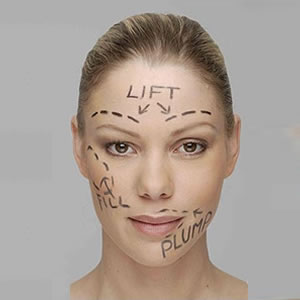
We have become contaminated with inaccurate information that tells us that we are not good enough. Turn on the TV and look at our commercials. There are ads trying to persuade us to get that cream and cleanser to fix our skin so that we can “gain confidence”; there are companies pushing us to invest in the newest supplements or body wraps so that we can jump-start our weight loss journey; because clearly, there is a scientific correlation between decreasing weight and increased happiness. Right? WRONG.

cr4

The entire realm of commercialism invests billions of dollars in attempting to brainwash us into believing that happiness can be bought. If we just had that perfect cream to cure our skin,the perfect supplement to help us lose weight, or the perfect book to change our lives, we would be happy! And, look at our companies. They are bent on trying to convince us that THEY have magically formulated  the “perfect” item that is going to give us everything we have ever wanted. 

Its absolutely heartbreaking. 

It is truly unfortunate to comprehend how deeply these elusive expectations have infected my life. It’s the same sentence OVER AND OVER again, : “I will be good enough when…” …when I get my Ph.d, when the children I don’t even have yet tell me I’m a good mother, when I’m able to complete a marathon, when I have the perfect body, clear skin, etc. 

What about now? Why am I not valuable enough to be loved now? I am a work in progress and I will always remain a work in progress. Does that make me invaluable or unlovable?—No, that makes me human.

Picture 8

This brings me back to the numerous questions about fitness—particularly, using fitness to change something that we don’t like about ourselves. We get so stuck in trying to fix what’s wrong with us that we never even stop to figure out why we feel unhappy.  What do we not like about ourselves? What makes us unlovable?

We may not like the way we look–we may despise something about our physique or appearance. Some of us may loathe our tendencies–the way we feel, the negative thinking patterns we’ve acquired. Others of us may not be at peace with our behaviors–the things we have done in our lives, the things we may still be doing, the hurt we have caused to ourselves and others. Futhermore, we may be dissatisfed with our circumstances–our career situations, and our relationships. 

I get it. It’s not always easy to like yourself. But, when did “being yourself” become such a taboo? Who decreed that we must be in constant competition with one another? So often, I feel as if my life is lost in trying to “conform” to societal norms better than everyone else. Sure, society thinks that helping people is great, but I want to be better than you at making other people feel better. HUH?!?!

And so commences, the dangerously fickle competition.

blog

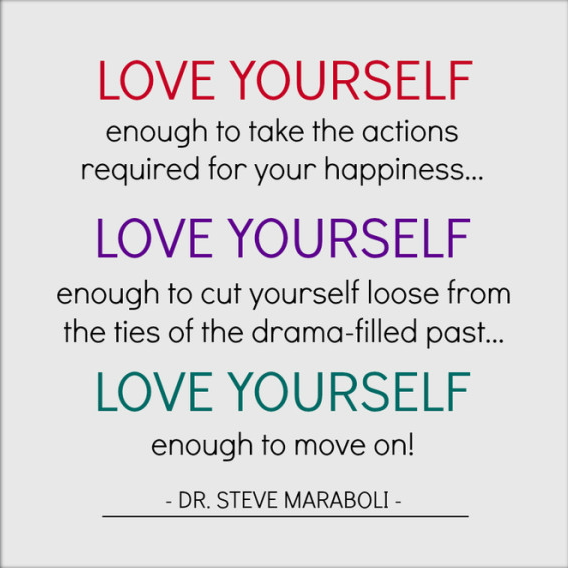
What if you could love yourself, exactly as you are? Without changing even one thing? 

What is holding you back from doing that? 

If you really trace it back, it is not the thing you’re bent on changing about yourself. Those muscular quads, the pimples, receding hairlines, odd-shaped noses, the “fat rolls”–these are not the things that are TRULY holding you back. What is, however, holding you back is the self-defeating BELIEF that YOU HAVE TO BE PERFECT to be LOVABLE, HAPPY and OKAY. 

cr6

You don’t.

You can be comfortable with who you are, even if you have imperfections. And even more so, other people can be happy with you too, despite your various imperfections! We are all imperfect. We are all insecure about one thing or the other. Though we may struggle differently, we struggle nonetheless. We know what it feels like to be ashamed, scared of judgement, unhappy, dissatisfied and isolated. Whether we want to be or not, we are connected with one another. 

Picture 9

I want us to ACCEPT ourselves exactly as we are. Will you do something with me? Will you aid me in putting a hiatus in the endless cycle of panicked “fixing” “picking” “prodding” “calculating”? 

“I love and accept myself exactly as I am, and in doing so, I accept the world and other people exactly as they are.” 

Repeat that to yourself, as many times as necessary. Repeat it, even if you don’t believe it yet. 

Accept it. You’ve got a lumpy tummy, a big nose, horrible acne, noticeable hyperpigmentation, panic attacks, a stress disorder, a mental illness, a physical illness, thighs that touch, clothes that don’t fit, a list of people you’ve hurt, things that you regret. Accept all of it. 

Accept it. And, now, stop looking at it.

It is really the looking, relooking, and oh–that one more look that is killing you. Hush. End it. It is there. Yes, you have an odd-shaped nose. Yes, you are overweight. Yes, your face has pimples. Yes, you really did let that partner get away. Recognize it. See it. And let it be. It is there.

Picture 12

Chances are, it is still going to be there the next 50 times you check too. In conducting this neverending recalculating, looking, remeasuring, and re-analyzing, we all inadvertently MAGNIFY our imperfections and insecurities. Some of us magnify them to the point that when we look in the mirrors that is ALL we see. And, we begin to fearfully fret that THAT is all others see too. 

It’s okay. Let them see it.

Accept it all.

It is there.

Let it BE.

And, shift your focus to something else.

By accepting and letting things “be”, you are releasing the WORRY associated with your imperfections, not the imperfection itself. It is all okay. You are not going to become a lazy slug and not get anything done. You are not going to turn into a failing student because you’ve “accepted” that your grades are a certain way. You are not going to gain 300 lbs overnight because you’ve “accepted” that you are currently overweight.  You are not going to end up in a mental asylum because you’ve “accepted” that you are currently suffering from clinical depression.

Picture 10

KNOW and BELIEVE that you are going to work from this place. “Rock bottom” is going to become a SOLID and DURABLE foundation to build the rest of your beautiful life upon. You are not going to slip into mediocrity. You don’t have to be uncomfortable with who you are to improve on the person you want to be! Contrary to popular belief, those things are not mutually exclusive. They CAN and DO work together. You CAN be comfortable with what you have, while working towards something better. 

Picture 11

You are freaking awesome, but you are going to keep becoming even more awesome-er with each passing day!