“Unpacking WHAT?” I blurted out aloud, years ago. I was in the middle of attending a continuing teaching certification course.
“Unpacking standards,” the speaker repeated, much slower, almost to be clapping out the syllables.
Judging by the blank stare on my early teacher face, she looked up to my Bambi, doe-eyed self, and repeated, once again, “yes–really figuring out how you measure the things we ask you to measure.”
Floored. I was floored. My brain had never thought that far.
We have these objectives–these assessmenttools–“points of relativity” from which we are supposed to evaluate humans…in comparison to how they are doing to other humans. 💁♀️
Each educator at every level has seen them, heard of them and even had them beat into their nightmares.
Yet so few times do we have John Maxwell type “leaders” who truly take time to explain what these subjectively defined target points mean. In my 8 years of teaching, I’ve seldom had someone really break down what each objective means– into real world, observable, measurable examples I could observe in the classroom.
How am I supposed to know what a 5 year old looks like when they are “applying knowledge of structure and phonics to decode text?” That sentence alone makes my own head explode 🤯
So here is a blog post about unpacking self-compassion.
~Self Compassion: What it is it about?~
Self-compassion, as defined by researcher Dr. Kristin Neff, involves treating yourself with the same kindness, care, and understanding that you would extend to a loved one in distress. The three core components are:
1. Mindfulness
Observing your feelings without judgment or over-identification.
This is the one with whom I continue to wrestle a challenging relationship with. WE have a lot to learn about one another (which means…I have a lot of surrendering to do #nottodaysatan
2. Common Humanity
Realizing that suffering and imperfection are shared human experiences.
Curiosity is a safer friend to sit with alone; sometimes the daunting intonations of its’ companions, shame and hope, are more arduous to sit with together.
Realizing that suffering and imperfection are shared human experiences.
3. Self-Kindness
Acknowledging your pain with warmth and understanding, rather than criticism.
Self-compassion isn’t self-pity, passivity, or a lack of accountability. Instead, it’s a powerful tool to support “emotional well-being”, especially for individuals processing trauma or working toward healing:
Why Self-Compassion Matters
When life’s challenges become overwhelming (and they will), self-compassion serves, as an anchor. Research shows that compassion-focused practices can reduce anxiety, depression, and feelings of shame, key obstacles for those healing from PTSD or cPTSD. A lack of self-compassion amplifies self-criticism and isolation, leaving many trapped in cycles of guilt or fear. Embracing self-compassion creates a foundation for healing and reconnecting with yourself.
In a fast-paced world that values hustle, achievement, and productivity, self-compassion often takes a backseat. For many—including those dealing with trauma, PTSD, cPTSD, or the aftermath of difficult experiences like assault—
Practicing kindness toward yourself can feel foreign, or even impossible. However, self-compassion is a vital step toward healing and empowerment.
In the next informative blog post, you’ll discover 10 simple yet transformative ways to cultivate self-compassion, backed by mindfulness, presence, and gentle practices you can integrate into everyday life.
They say it is better to have “loved and lost” than to never have loved at all.
I disagree.
I lost myself in you.
I almost lost myself TO you, literally.
You killed me once.
The problem, you see, is that I followed faithfully in your footsteps.
I chose to stay.
I chose to retell, repeat, and relive the tormenting narrative you created for me.
I chose to kill myself, slowly—arduously—painfully—every single day—for decades.
Until now.
For as long as I can remember–my life, both figuratively and literally, has been in your hands.
As I sit here, sifting through the decades of dejection, I can wholeheartedly tell you that no person is worth sacrificing your sanity.
Day one or “one day…”?
Its finally day one.
Today is the day I finally let go.
I am shakily, and finally choosing differently.
& do you know the most pathetic part?
I am so scared.
Believing the delusion that your violence might have been “love” is far easier than accepting the fact that the “love” I romanticized was never there at all.
I am so deathly afraid to let you go—
—even though you have been the most toxic, unhelpful relationship in my life…
I feel fear.
& it’s not because of the alternating black eyes, hushed bruises, or broken bones…
Those heal.
I’ve watched too many of them fade from my body like mirages on a hot day.
I trace my fingers over the ever-so-familiar, black-blue spots I’ve, now, come to find disturbing comfort in.
But they’re gone—
All that remains is the eerie echoes of your query whispers.
“If you looked like (her) _____, or carried yourself like (her)_______, then I wouldn’t be beating you…” you echo menacingly through time, “the reason I’m doing this is because there is something INHERENTLY wrong with you. You deserve this.”
Your words ring in my brain– taunting me, haunting me— till the singular motivation becomes about escape—
I must outrun the crippling hatred erupting relentlessly within me.
And over decades of deterioration…I have tried to “escape”.
But I have no room to talk. You were right–
I couldn’t even succeed at the one thing you’ve told me I should have always done.
The truth is, as you say, I am a coward.
I am spineless, identity-less, and lower than the scum on the bottom of the pond..
I couldn’t do it successfully. I came very close.
But “almost” doesn’t cut it.
Who expected a service dog to lounging silently on a neighbor’s porch on a freezing December night?
2020—
I ran 5 miles at my fastest pace–
My avid runners–ya’ll would be so proud of my splits!!!
I even beat my PR (personal [best] record)
& after approaching fatigue…I looked around to double check that no one was within sight.
& in the deafening silence of the night…
I carefully wrapped the ankle weights I use for strength training around my weary legs…
And I….jumped…into the deepest pond I had scouted out a few weeks before.
The clock had struck midnight—it was finally my birth “day”…December 4th.
The paralyzing pressure of the water, the languish in my legs, and the curling coldness enveloped me as I was unable to swim to the surface.
And the last thought I remember thinking, as I sank slowly to the bottom
—was tragically about you.
I thought about your cruel words.
“If you want to do the world a favor, Maham…”, you snarled in my slowing brain “just go ahead and do what is needed to be done”
And…. I couldn’t do it.
But I tried.
That damn service dog had alerted his owner with his incessant barking–causing a complete stranger to walk out–and see what was happening. 911.
“Just do it! kill yourself.” I heard under the murky, dark water.
My arms, naturally, fought to try to get to the surface.
But I couldn’t.
It was getting harder and harder to breathe.
I could feel my my lungs give out.
…and I fought—when it came down to it–I FOUGHT to try to get back up to the surface….
Until I heard the final echo of your voice that night….
“Everything you touch turns to misery anyway.”
I heard those last demeaning words…and I stopped fighting.
In that moment, I made the decision to let go.
I let flailing arms fall to my side and closed my eyes as I sunk towards the bottom.
& that was my last thought before losing consciousness.
The next thing I remember is waking up on the grass, on a stretcher, surrounded by EMTs pressing on me—and there it was—OUCH!!!!
All of a sudden, I was yanked back into reality—
–I was choking on the water that was, then, fervently flooding out of my mouth and nose at an unbearable pressure.
I have a momentary snapshot of me wrapped in a bright silver insulating blanket.
& I lost consciousness again…
I was struggling with hypothermia…[as I would come to find out later’
And finally…
I awoke in the ER..
I looked around, absolutely bewildered and puzzled.
& before I could fully become aware of what had happened, a deeper realization struck a chord so deep in my heart.
‘I am a failure’–I thought to myself. And I was. And I may still be. I was a failure in every sense of the word—.
I couldn’t even kill myself “right”.
But neither could YOU.
“I wish he had taken away your life when he ‘allegedly’ took your virginity,” I hear you screaming in my mind.
If anything, you have made it painfully clear that your life (and the lives of many others) would be a lot “bit brighter” without my presence.
“If you weren’t such a whore…then maybe you wouldn’t have gotten raped,”…
–at 14 years old—-with a knife–
Yes. The knife was utilized to “pop” my cherry.
To you, however, that’s irrelevant. It’s impertinent.
It is always my fault.
It has to be.
If I want to keep you in my life, I must always “dim” my light so you can shine brighter.
and so it begins…yet again…
An assortment of your agonizing remarks cycle through my head—at a merciless speed—
—over and over again—
My brain gets stuck on repeat like a broken record playing the same few tunes repetitively.
The tunes of my record are the stuff of nightmares.
The torment of your insidious insults continues till I want to rip my own head out of my body.
HELP!!!!!!
No human can stay immune to the missiles of such fiery self-hatred forever…
So what does one do when that unrelenting, merciless abuse starts to come from their own brain?
& just like that–
—I find myself thrust into the 9th circle of hell from Dante’s Inferno.
& so…I do what I’ve always done…
I dissociate.
I leave my body.
and for a few fleeting moments, everything…feels… a little bit ‘lighter’—a little bit further.
As your ridiculing remarks become more muffled and harder to decipher,
the ominous panic boiling inside of me steadily slows to a soft, sufferable simmer.
and there “I” am…soaring…above it “all”.
There I am– simply watching a homosapien named “Maham” go through some not-so-cute stuff.
I watch my body curiously as it floats above me—
and “I” become lifeless.
& just like that—
All the pieces of my fragile psyche shatter into sharp, serrated fragments once again–
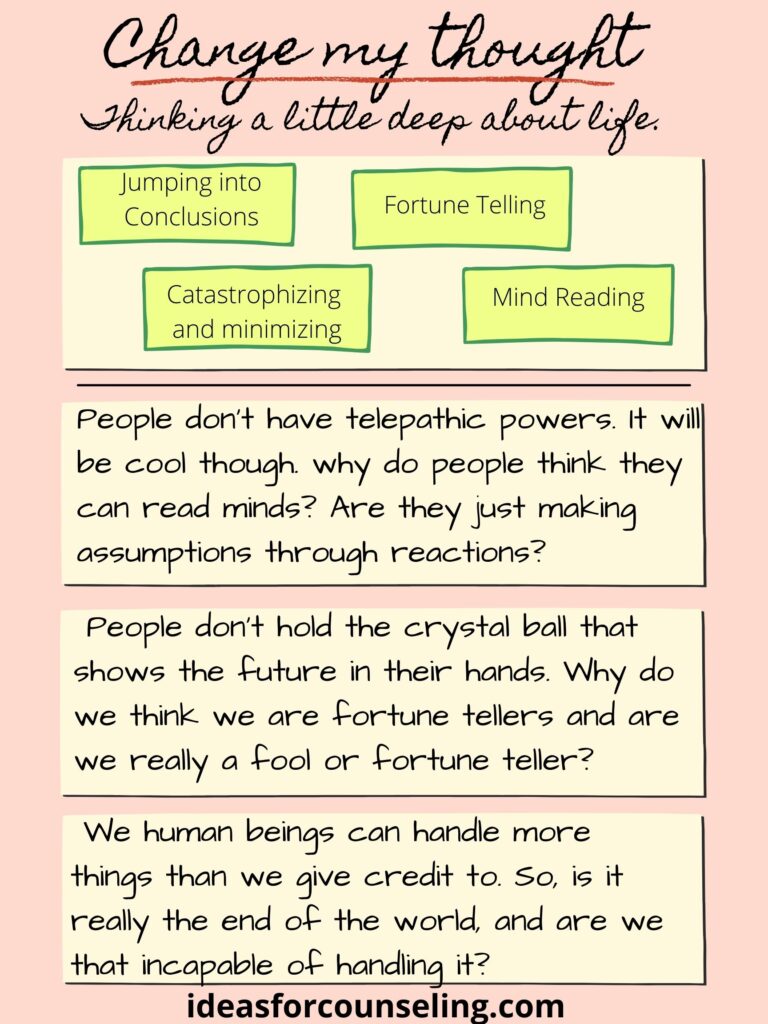
A twin sister of mind-reading, who happens to be just as convincing in the least helpful ways is….
drum-roll!!!!!!
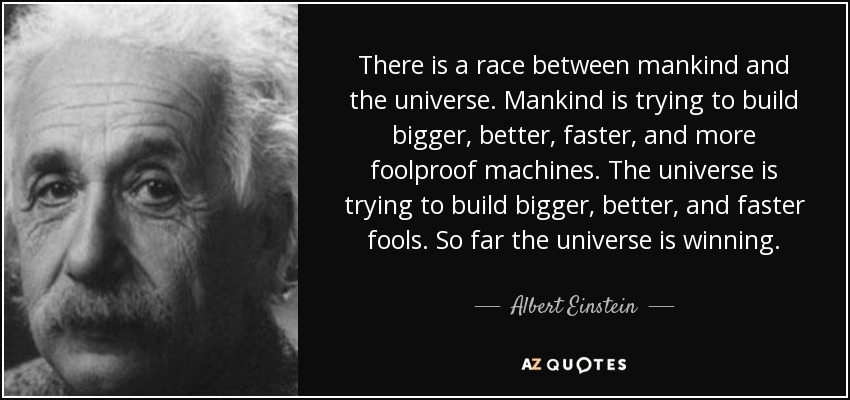
Albert Einstein, one of my favorite scientists said: “we cannot solve problems from the same thinking patterns we used in creating them.” This means, we cannot use the same patterns of thinking that manifested the problem to try and construct solutions that will actually work.
That is why it is so essential to become aware of these common cognitive distortions. Once we can develop a meta-cognition, of sorts, to observe the faulty patterns of cognition our minds may have developed over time, we can begin to solve deep-seated issues within our psyche.
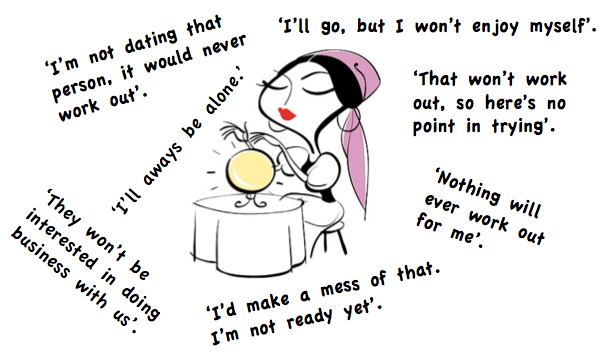
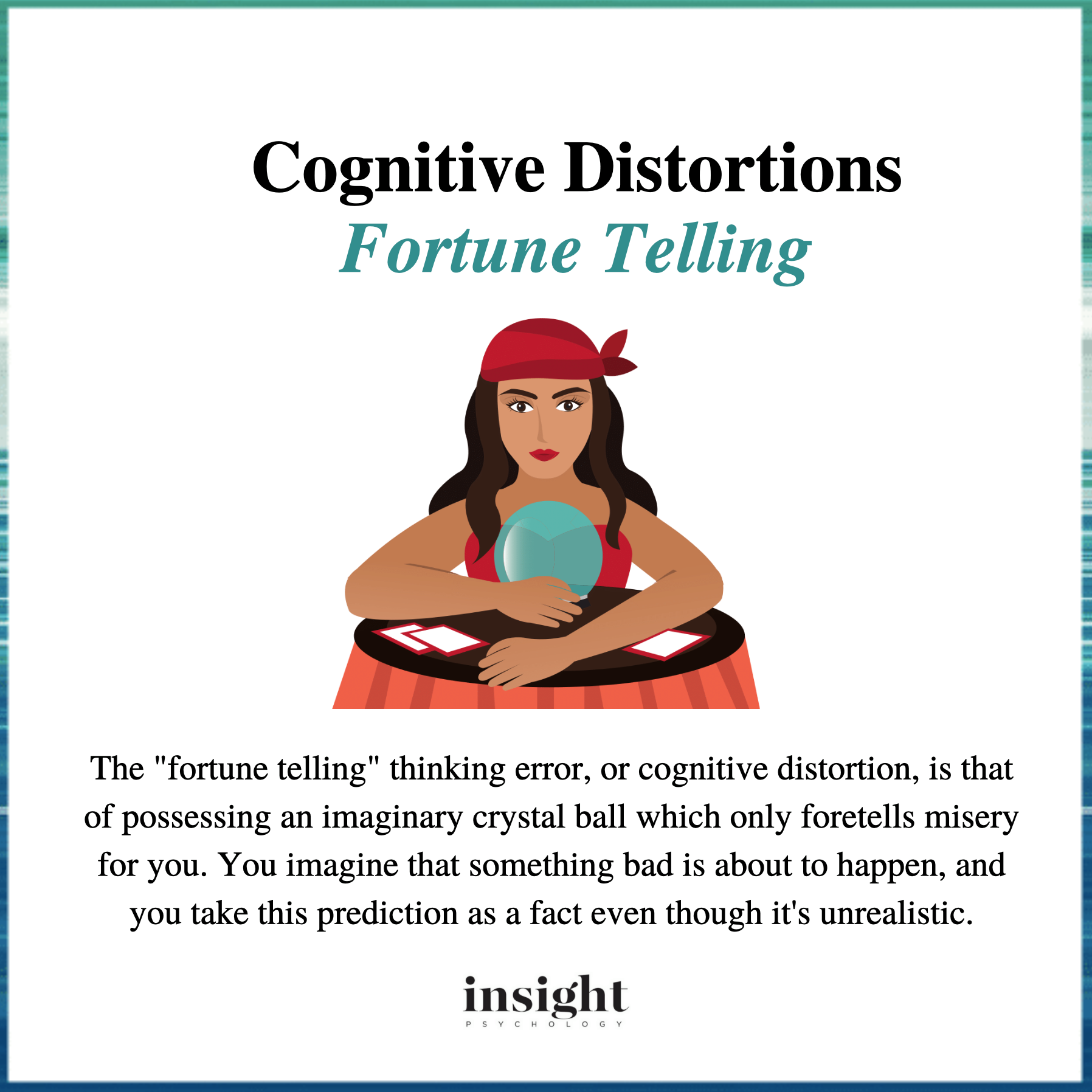
Fortune telling, much like mind-reading, is a branch in the family of cognitive distortions associated with jumping to conclusions. Fortune telling is a cognitive distortion that predisposes us to favor and predict a negative outcome without realistically considering the actual odds of that outcome.
This type of predilection towards worst-case scenarios is usually linked to anxiety and depression. Most often, those of us struggling through an active anxious or depressive episode display skewed thinking about the world and ourselves.
In fact, when I was practicing counseling in New Orleans, fortune telling was actually one of the most common cognitive distortions that came up for my clients. They seemed to have this eerie unbased “knowledge” that things would just end in a very catastrophic way without any real logical evidence to believe so.
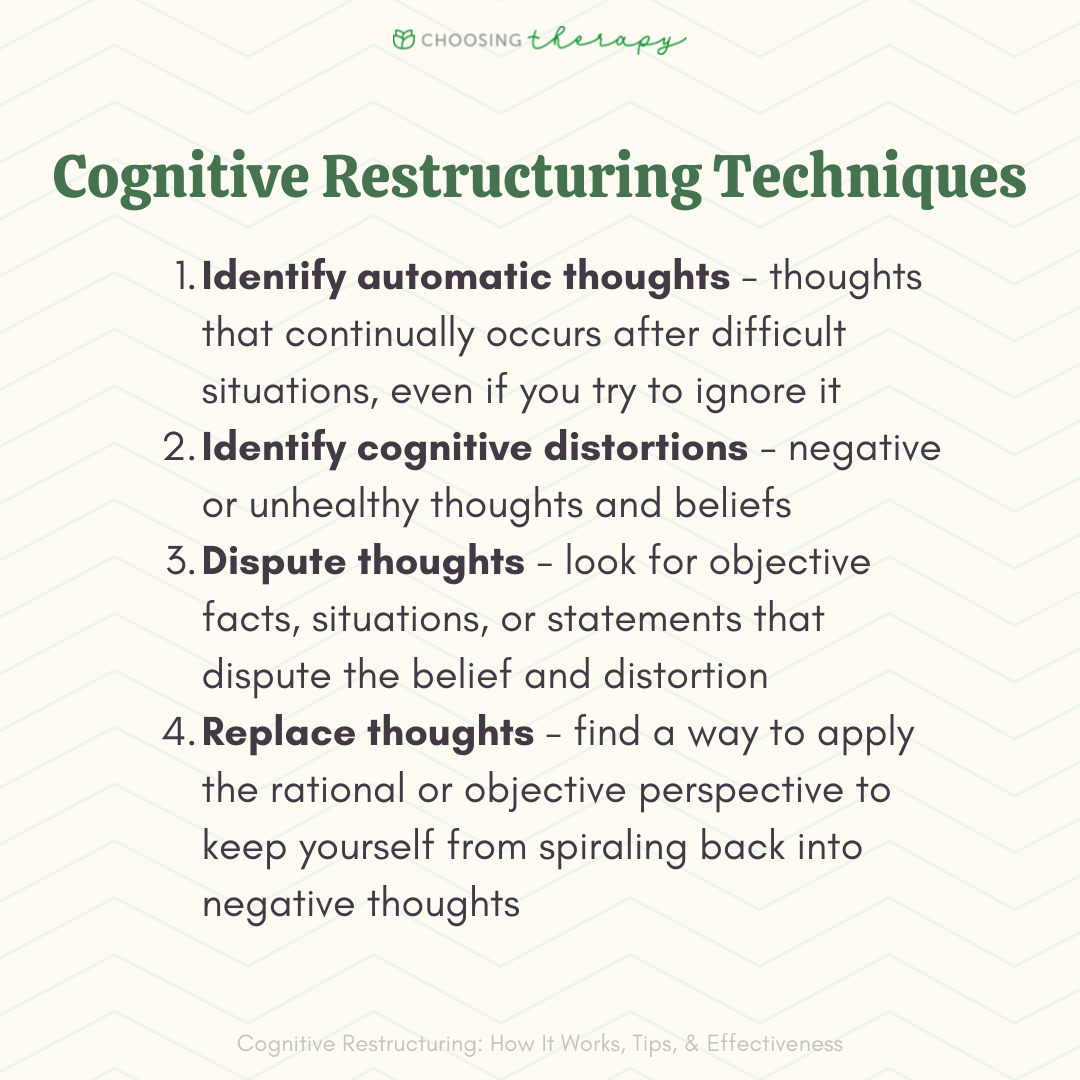
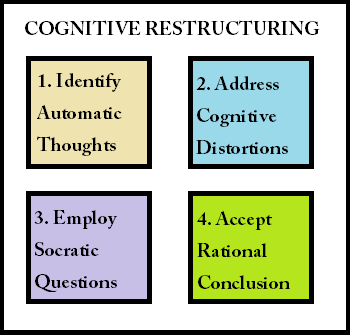
The process of taking some of these rehearsed faulty patterns of thinking and retraining the brain to replace them with helpful, more realistic and healthy patterns is called cognitive restructuring.
In psychology, especially among therapists that employ the CBT modality, cognitive restructuring is a technique used heavily to help individuals become aware of the age-old narratives they come in telling themselves. After appropriate reflection, clients are then challenged to analyze whether or not they would like to change their self-talk and automatic narratives. If clients decide that the benefits of change outweigh the price of staying the same, the therapist works directly with the client and helps reframe unhealthy automatic core beliefs to more helpful, healthy and productive ones. That is the goal of cognitive restructuring.
Our deepest beliefs, or cognitive schemas, are essentially the byproduct of a well-rehearsed story that we have knitted together through our own lifespan. Some of the meanings that we assign to our experiences are conscious, however, the process of forming our patterns of thinking are largely done by subconscious sources.
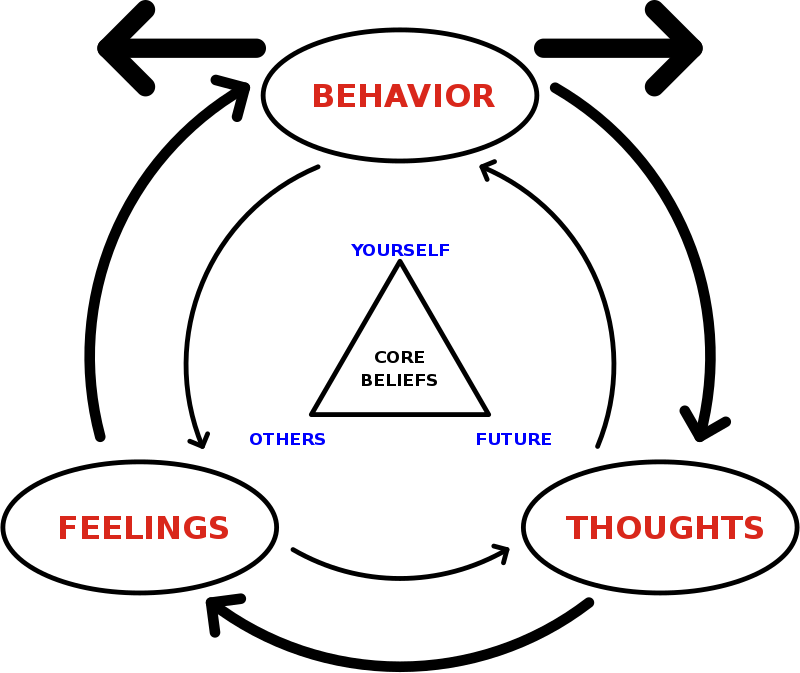
We see our beliefs reflected in our thoughts, feelings and actions. Our behaviors are the closest indicators of our true internal thermostat and core beliefs. The simplified medical way of looking at cognitive distortions is that once patterns are repeated, the brain simply learns an efficient, easier pathway of firing to arrive at a faster “action state”.
Here comes out the nerdy part of me! Something you may or may not know about me is that I pursued a double bachelors in Biological Sciences and Organic Chemistry in college. I graduated valedictorian of the college of sciences from College of Charleston with a summa cum laude. Studying the human body so closely sparked an interest within me to try to understand the mechanisms of the neuroplastic mind. That is precisely why I pursued my masters degree in Psychology and Counseling with a specialization in clinical mental health.
Anyway….
I want to quickly, and simply (hopefully) explain how our brains learn. The reason for this is because once we all are familiarized with the basics behind memory recollection, and how our brain creates meaning, we can begin to work WITH its natural wiring to develop more helpful patterns of thinking.
I view human beings as holistic creatures, and in no way would I ever advocate working against certain parts of ourselves. We are a unique collection of experiences, thoughts, behaviors, actions, cultures, and feelings. The more we understand each one of those compartments, the faster we can work with all facets of ourselves to improve overall life quality.
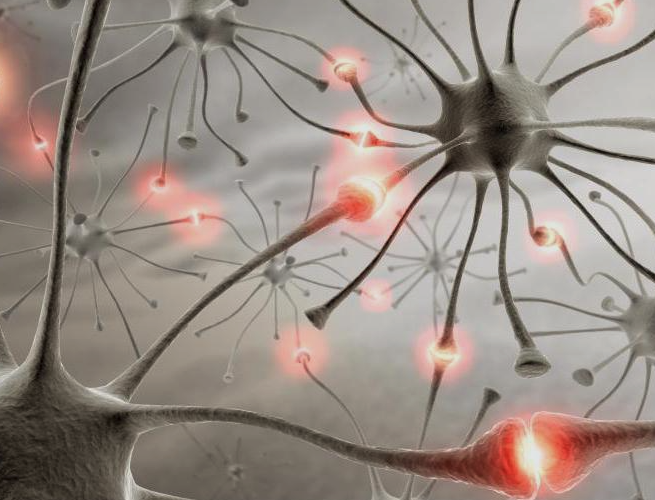
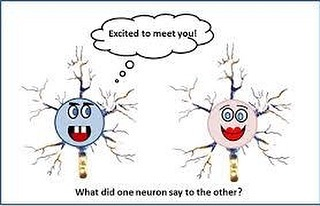
At every moment, our brain orchestrates a complex symphony of perfectly coordinated, and intentional signals across billions of neurons. These neurons, then, transmit the signals through trillions of synapses, lighting up pathways of the brain that are associated with a similar event (firing of dendrites). Becoming familiar with this complex neural circuitry enables us to start to understand the processes that work together to enable all aspects of brain function.
When we are learning something, neurons in different parts of the brain communicate with each other. If two neurons interact frequently enough, they form a connection that allows them to transmit messages more easily, efficiently and “accurately” (or so it thinks).
The more often certain neurons communicate with one another, the more fortified their connection gets. As a result, it becomes easier & easier for our automatic thoughts to follow in line with that same familiar thinking pattern. Use it and improve it!
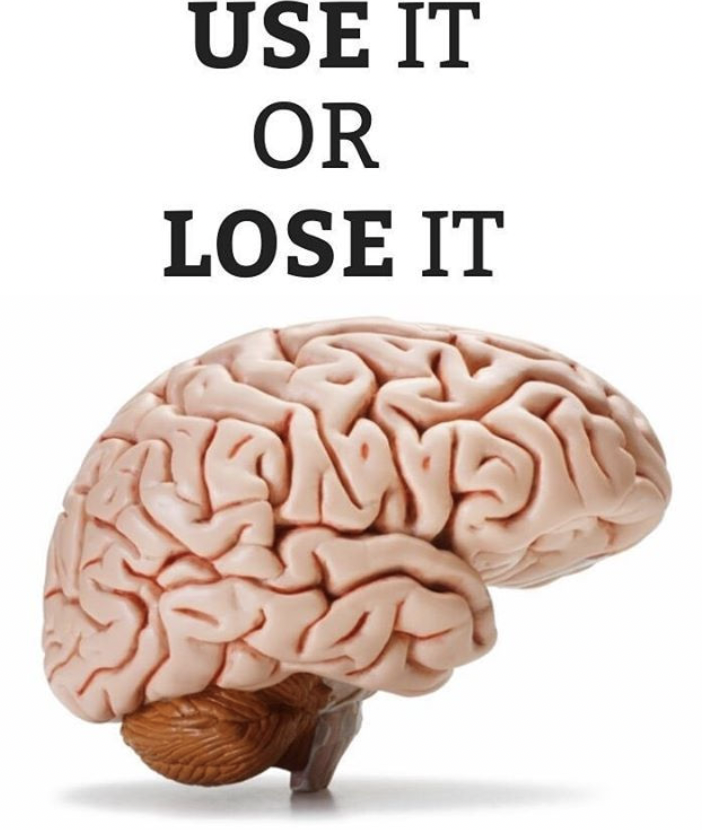
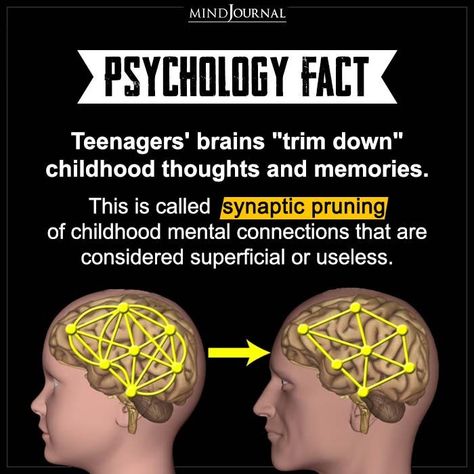
Similarly, the principle “use it or lose it” also holds true. Because there is such an infinitely overwhelming number of different pathways our brain cells can fire, most human beings tend to undergo a process of synaptic pruning. Essentially, “synaptic pruning” is just a fancy scientific way of saying “use it or lose it”
As we grow older, neural circuits that are not being actively engaged in performing tasks begin to degrade. Quite literally, this means if we do not use an area of our brain for a prolonged time, we will lose the function that was previously stored there.
The hope of so many psychological modalities lies in the neuroplasticity of the brain. Our saving grace lies in the fact that we can, with time and consistency, retrain our brains to think (and eventually, believe) differently. We have the power to wholly replace negative thought patterns with positive ones–literally, changing the very wiring of our brains.
That is some pretty powerful stuff.
If we have learned it, we can unlearn it.
Furthermore, we can also learn something else–something entirely new—something more conducive to our well being.
This is where cognitive restructuring can literally change our lives (if we let it).
Much like everything else, it takes a lot of practice and it takes times. Therefore, it is important to be gentle with ourselves throughout the process of rewiring our thinking. We didn’t just “think” ourselves into who we are overnight. By that same token, we cannot “outthink” ourselves into somebody new overnight either.
Tip #1- Challenge your thoughts by asking very basic, simple questions.
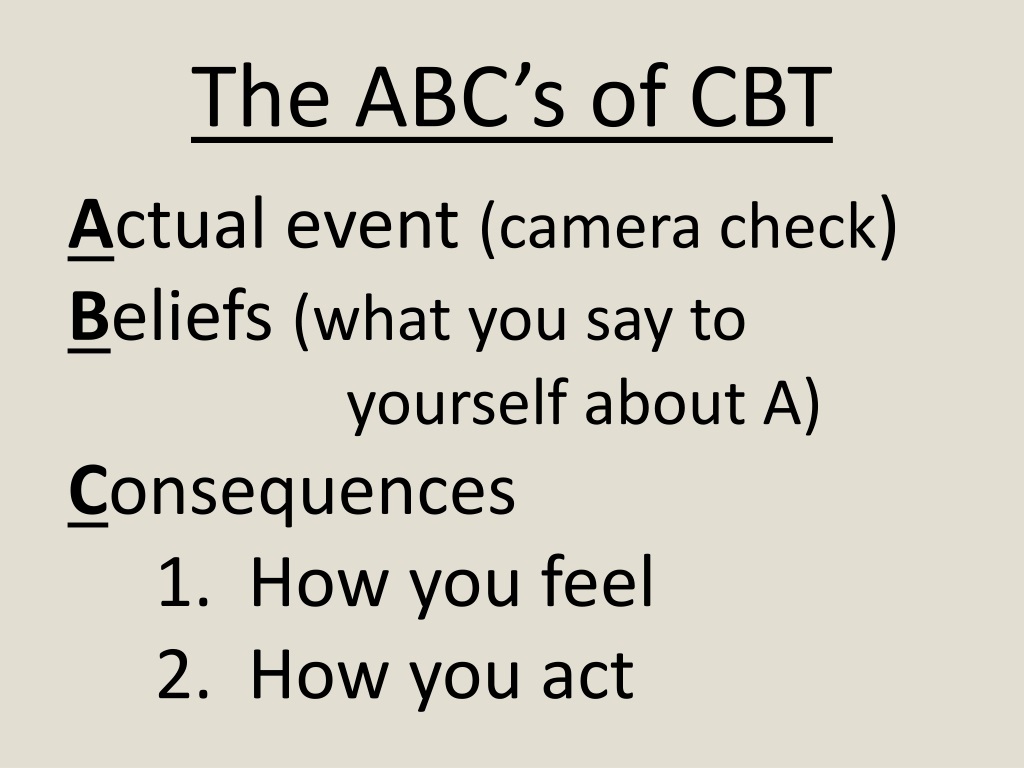
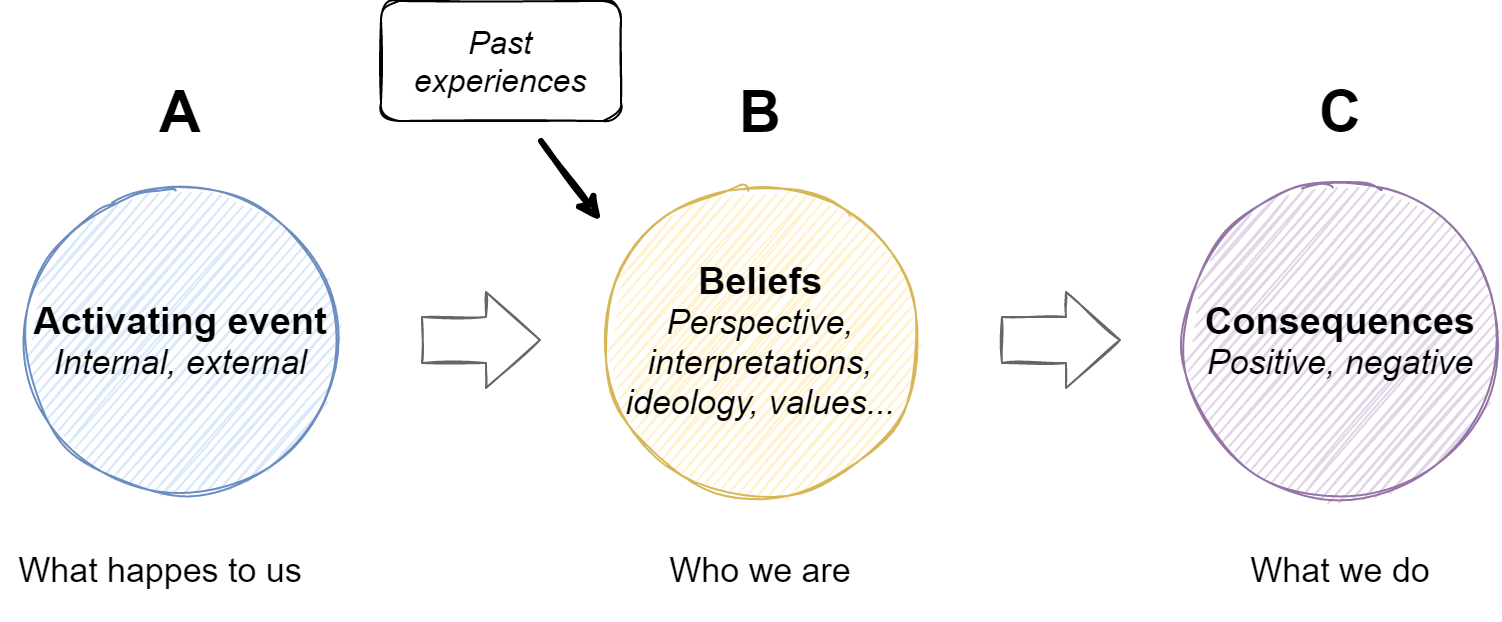
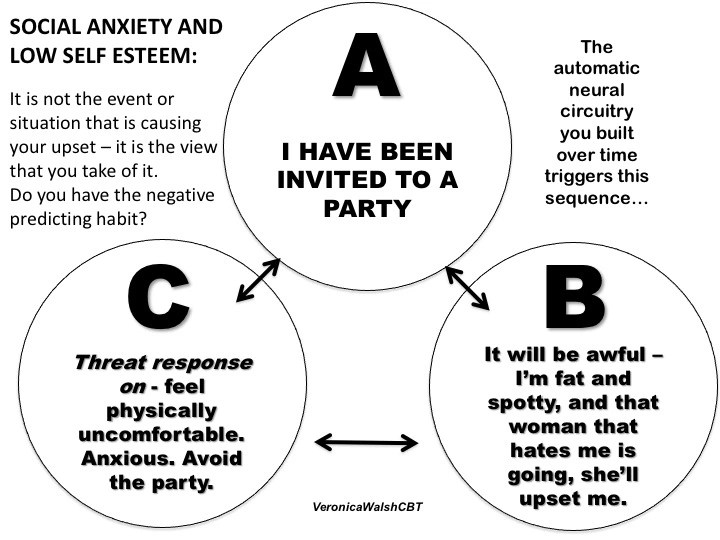
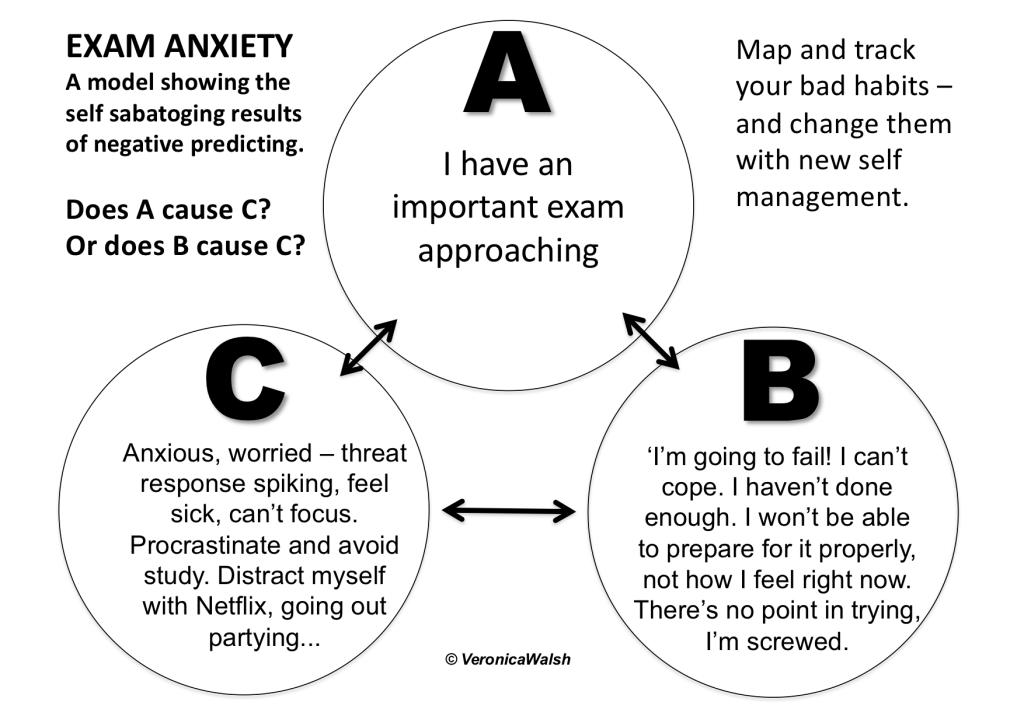
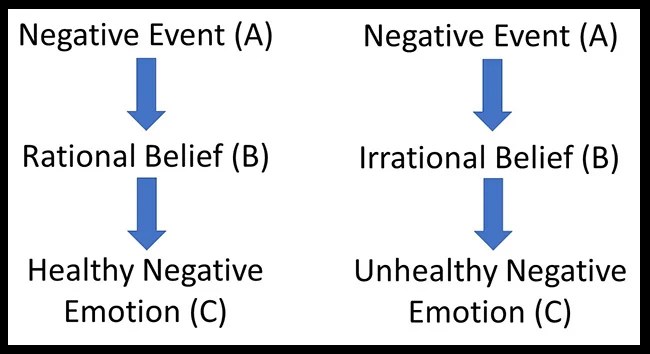
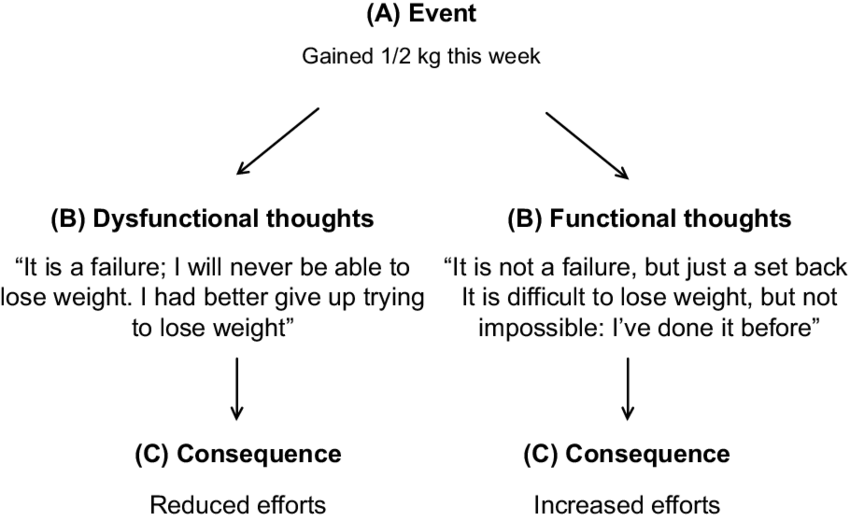
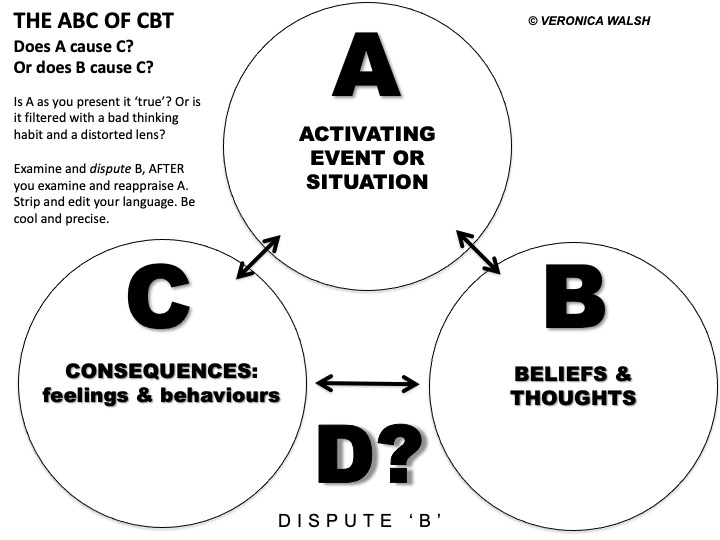
Tip #2- Use the ABC model to help slow down and track thoughts so that we can begin to change them.
What is an “ABC” Model?
The goal of conducting the ABC analysis is to truly get to our core beliefs that trigger our thoughts and feelings. Once we target what our core beliefs are, we can analyze them and figure out if they are based in reality and if they are helpful to us or not.
ABC models are most helpful when done on paper. There is something about writing things down that allows our brain to slow down processing and truly pause.
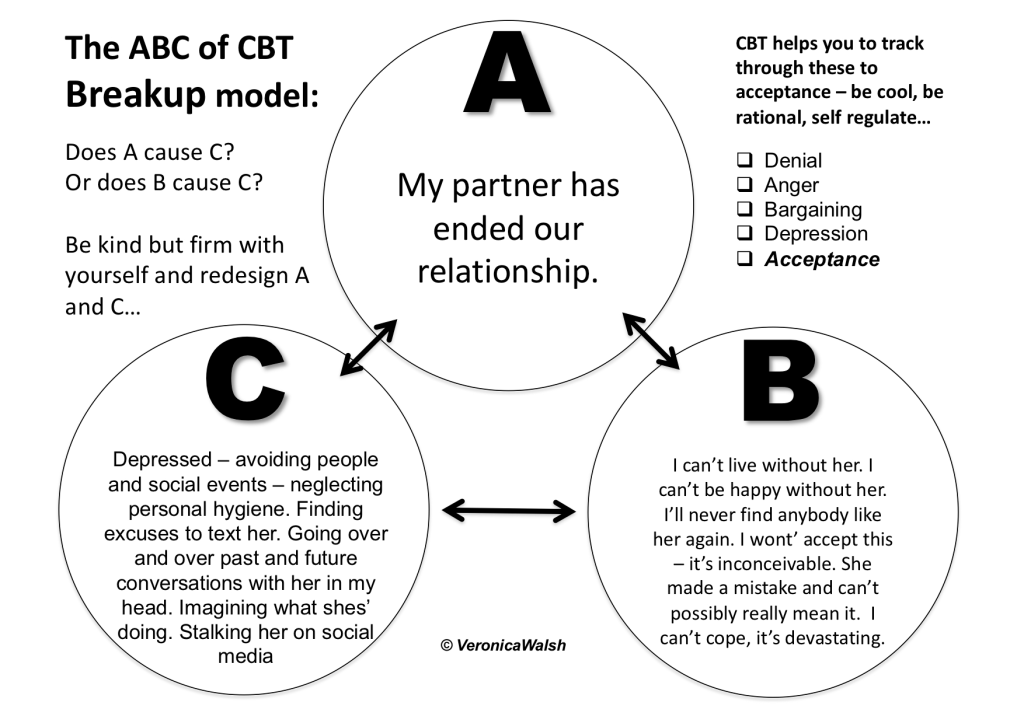
Examples of ABC models that have been done
Example 1: End of Relationship
Example 2: Social Anxiety
Example 3: Performance Anxiety
Tip #3- Use a “Behavior Chain Analysis” to monitor new and old behavior
The basic set-up for a chain analysis is as follows:
I encouraged all my clients to do at least two behavioral chain analyses. The first one should depict what would (continue to) happen in each of the categories if the core belief was left unchanged. The second one should ideally depict what would change in the respective categories if the core belief were to be challenged.
Example of Behavioral Chain Analysis utilized in CBT
Tip #4- (If you really want to do some serious cognitive “soul searching)…try some DBT or CBT worksheets that help prompt you to examine your core beliefs.
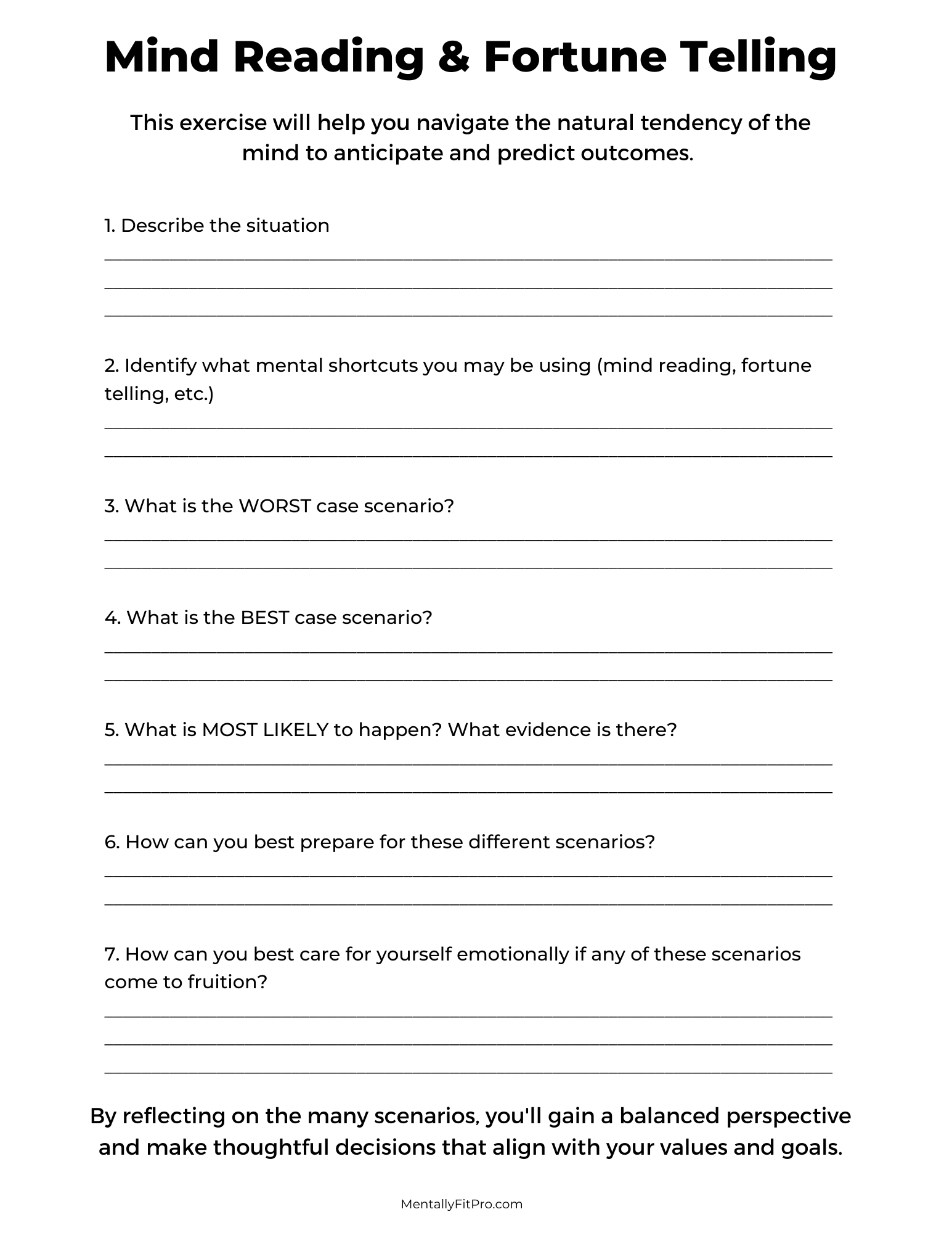
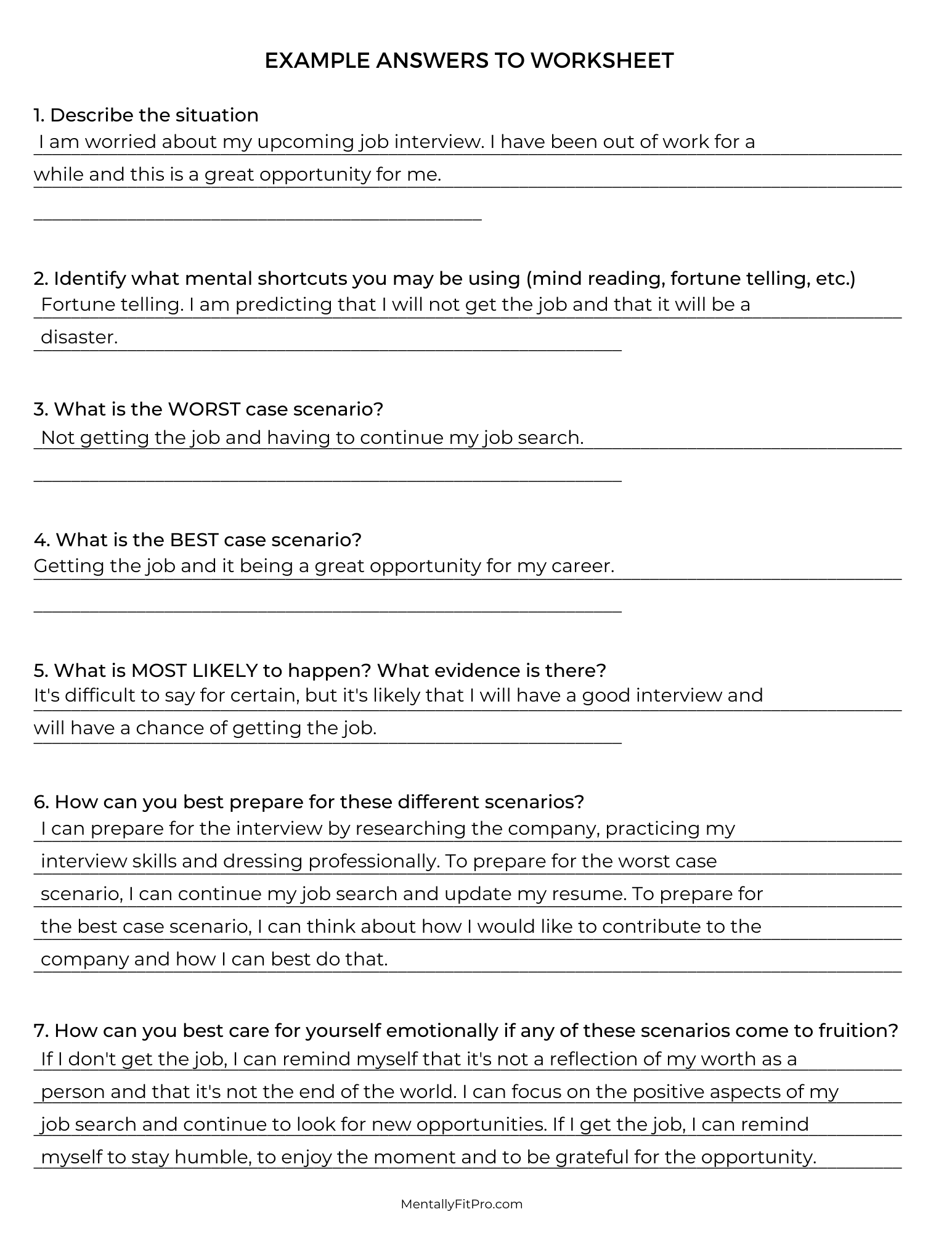
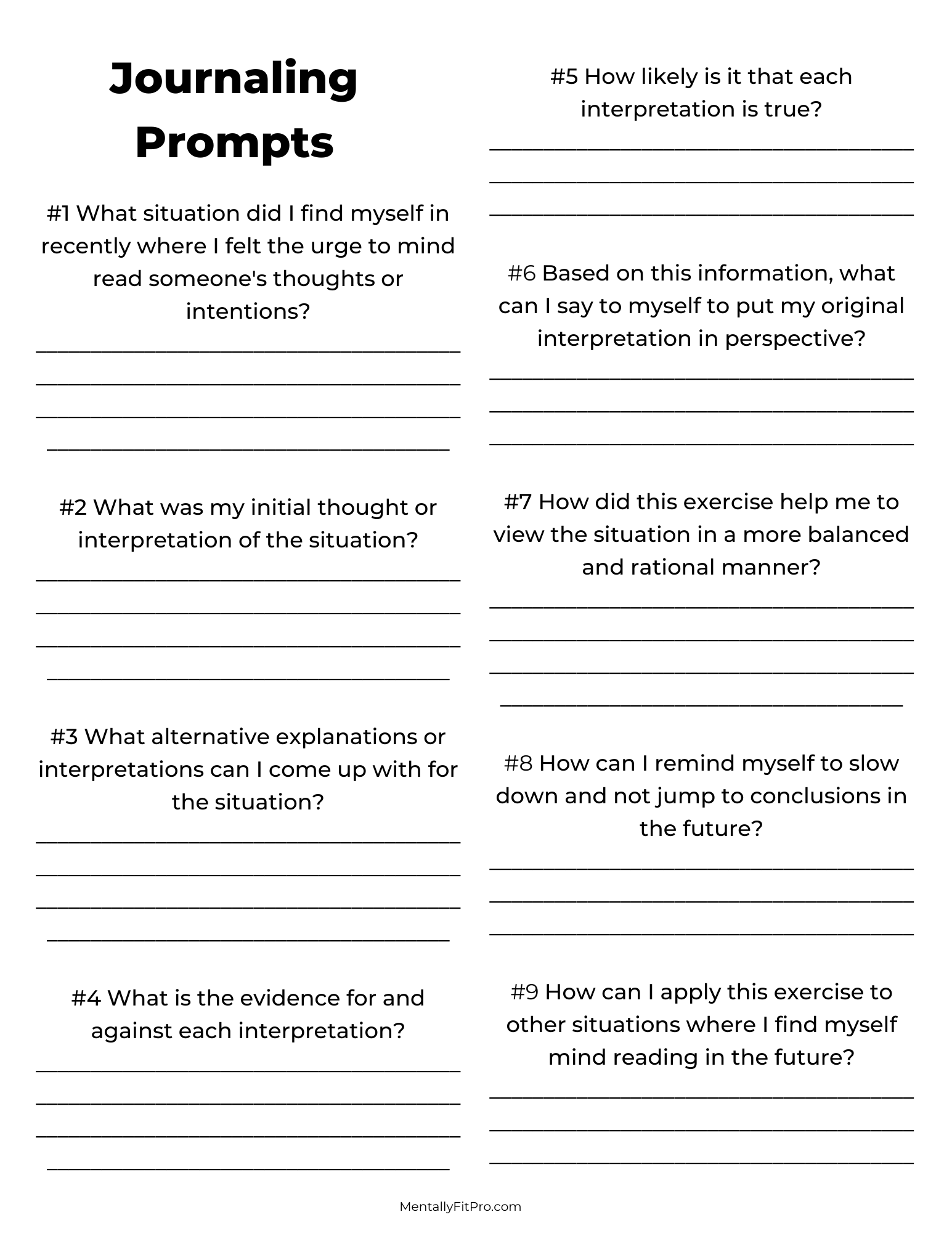
For our purposes, I am going to upload a copy of worksheet that I have used and given others to use when I find myself jumping to conclusions, engaging in mind-reading or becoming my own self-anointed fortune teller.














 abidmaham