Mush With Glitter

In Iceland, I asked life to happen without trying to curate the form.

Apparently, life heard me.

I did not realize the form it planned to stop curating was mine.

Rude.

Zero bedside manner.

Also–

Did you know that, before a caterpillar becomes a butterfly, it nearly dissolves?

Not metaphorically.

I mean, it becomes soup.

Technically, not every part of the caterpillar liquefies. Some structures remain while much of its larval tissue breaks down.

But “partially intact soup” does not make me feel significantly better.

I learned this while watching a woman explain metamorphosis to Mel Robbins.

“When you’re going through a very hard time,” she began, “one thing that’s very helpful–”

Debatable.

She explained that the caterpillar enters its cocoon and becomes mush.

“Like evaporates?” Mel asked. “Like literally?”

“Like literally.”

“That’s disgusting.”

Thank you, Mel.

This was apparently news to her, too. She had always imagined that the caterpillar simply grew wings out of its existing body.

Honestly, same.

That is more or less how the metaphor has always been presented to us:

Caterpillar → Cocoon → Butterfly

So neat.
So directional.
So graceful.

There are plenty of phrases meant to capture the unpleasant middle:

“It’s always darkest before the dawn.”

“The breakdown comes before the breakthrough.”

“Sometimes things have to fall apart so better things can fall together.”

“Trust the process.”

But I find it slightly mischievous that one of our most beloved metaphors for transformation conveniently left out the part where the caterpillar loses its entire recognizable shape.

Nobody mentioned the soup.

The entire ungraceful part was left for me to discover years later.


I’ve been thinking about my life recently–and about how, right before a transformation, the shape of the life we built can begin to dissolve.

Everything liquefies.

Mush.

Not attractive.
Not directional.

Just…there.

I wonder if this happens to other people, too.

If, right before we become something we have never been, we have to spend some time being nothing we recognize.

Being mush is scary.

From inside the cocoon, there is no butterfly yet.

There is only the loss of the caterpillar.

And yet, inside the caterpillar are clusters of cells that were there before it ever entered the cocoon.

Imaginal cells.

They are literally called imaginal cells.

Imagine that.

More precisely, scientists refer to imaginal discs or imaginal primordia–clusters of cells involved in forming the adult insect.

As much of the caterpillar’s old tissue breaks down, these cells begin developing into structures belonging to the butterfly.

Wings.
Legs.
Eyes.

All the pieces of a butterfly, apparently just hanging out inside a caterpillar.

Which feels a little unhinged.

The woman told Mel that these cells carry the roadmap–the blueprint–for becoming a butterfly.

Then she started talking about letting go.

Sigh.

About allowing yourself to be where you are.

I began to regret transcribing the conversation.

I do not enjoy discovering that a metaphor may be relevant to my life, especially when the metaphor requires me to:

  • surrender;
  • become soup;
  • and trust microscopic cells with an inspirational name.

But one thing she said stayed with me:

The story overlay is different.

Maybe the story is not:

“I am being completely demolished.”

Maybe it is:

“I am in a state of transformation.”

The experience might feel exactly the same from inside the cocoon.

But the story changes what we believe is happening.


And then, while writing this, I found an old video of myself.

The Universe, apparently, has lost all regard for subtlety.

The woman in the video had a crown on her head and a purpose she could explain.

She talked for fourteen uninterrupted minutes about:

  • loving the world;
  • changing one life;
  • and coming back softer.

She seemed to know who she was.

Bless.

A few months ago, I might have watched that video and built a case for myself.

Look at her.

Look at everything she survived.

Look at everything she accomplished.

Look at all the evidence that she mattered.

I don’t want to do that today.

I don’t want to turn my former selves into exhibits presented in defense of my existence.

I don’t want to prove that the mush was once impressive.

Because I don’t think the blueprint has ever been for a particular version of my life.

It wasn’t directing me toward a crown. Or a classroom. Or a book. Or a butterfly.

Those were forms.

Caterpillar.
Cocoon.
Butterfly.

Random alligator that no one asked for.

The form keeps changing.

But I have a feeling that, underneath every version of me, the blueprint has always been orienting me toward the same thing.

Love.

As a child, I said I wanted to love the whole world.

As a teacher, I wanted one child to know they mattered.

In a crown, I took it off and placed it on somebody else’s head.

And now, as mush, I am beginning to wonder whether I need a recognizable shape at all to keep moving in the same direction.

Maybe the imaginal cells do not carry an image of what I am supposed to look like.

Maybe they carry an orientation.

Maybe I don’t need to know whether I am becoming a butterfly, a moth, or some deeply concerning winged creature that immediately flies into a porch light.

For once, I don’t want transformation to become another assignment.

I don’t want to rush out of the mush.

I don’t want to demand that the new form introduce herself before she is ready.

I just want to be…mush.

Maybe with glitter.

The imaginal cells can do whatever they are doing.

The form can change.

The blueprint will keep pointing in the same direction.

Love.

That way leads Home.

The Pebbles Were Already There

On finding what changed when nothing changed

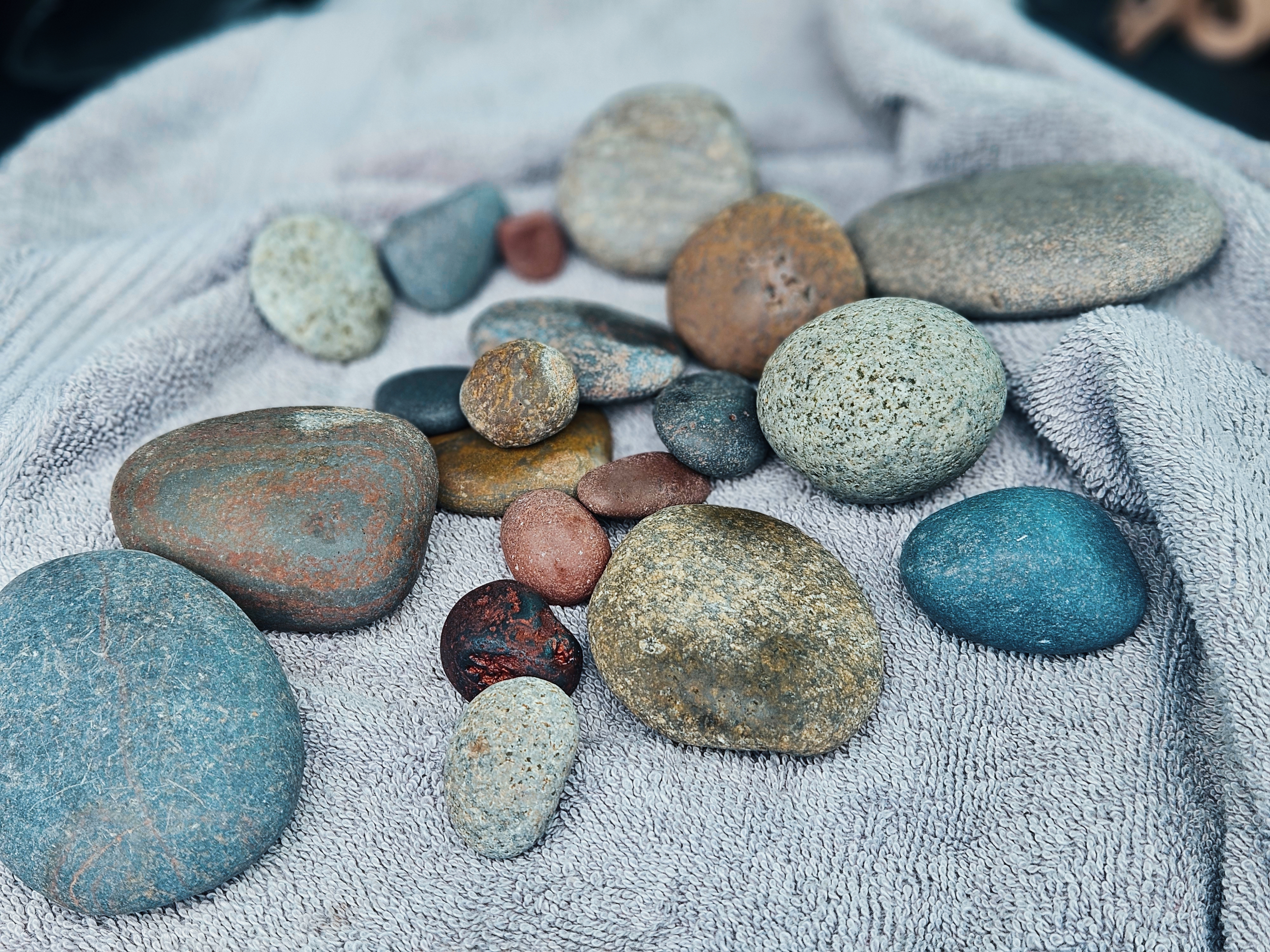
I started collecting pebbles on a black beach in Iceland.

I don’t remember deciding to do it. I only remember noticing one.

Then another.

One was pale and smooth. Another was dark, almost blue. One had a sharp edge; another fit softly into the curve of my palm. I began arranging them beside one another, comparing color, texture, size, and shape.

And something curious happened.

Every new pebble made the ones already in my collection more distinct.

The dark stone became darker beside the pale one. The smooth stone became smoother beside the jagged one. The small one did not disappear next to the larger stone; its smallness became more visible.

Each rock became more itself through connection to the new ones.

Maybe that was what Iceland wanted me to notice.

Beauty did not come from sameness.

It emerged through relation.

The lava caves were lovely beside the glaciers. The waterfalls were kinetic and majestic beside the silence of a lagoon. Fire lived beside ice. Ancient expanses of volcanic rock existed beside flowers soft enough to move with the wind.

And somewhere among all that grandeur was a silly little geyser erupting on cue, as though God had included a strict commitment to solemnity comic timing in the landscape.

There was so much unique beauty in every expression of God’s creative splatter.

Nothing had to become less itself in order to belong to the whole.

Later, when I looked through the pictures I had taken, I realized I had been collecting moments in much the same way I had collected the stones.

They were not simply “photographs of Iceland”.

They were photographs of Iceland through my eyes.

I had photographed a tiny human reaching toward a cat. A red door in an ordinary wall. A little statue of stacked pebbles that a stranger had left behind for other strangers to find and adore.

I photographed the things in which I found stories.

Or perhaps I did not have to find them.

Perhaps I only had to slow down enough to notice where the stories already lived.

A door suggested someone leaving and returning home. A child reaching toward a cat held an entire exchange of curiosity and tenderness. The pebble statue carried the touch of a person I would never meet—someone who had paused, arranged what was already there, and left a small act of meaning behind.

Maybe that is what I do too.

I place my attention beside something and say:

This was alive. This mattered. I was here.

Even the photographs carried my thumbprint.

My life is my meaning-making, my canvas, my stories, my connections—unique, odd, idiosyncratic.

Iceland did not look exactly the same through anyone else’s eyes because no one else had lived my life before standing there.

But I was not the only one creating meaning.

Life was moving through me too.

Water moves around stone without asking it to stop being stone. It finds the cracks. It travels along sharp edges. It softens, widens, shapes, and carries.

The natural forces of Iceland have been working upon the land for ages—fire rising through fissures, glaciers carving valleys, water wearing paths through rock.

Life has been shaping me in much the same way.

I make meaning from what happens to me.

And, what happens to me makes me.

Both are true.

Perhaps that is why I am becoming more like a turtle.

I want to carry my home with me.

Not because I no longer need anyone. Not because I want to retreat from the world. But because I am beginning to understand that home cannot only be a place other people allow me to occupy.

I want it beneath me.

Around me.

Within me.

I want to be able to enter caves, lagoons, airports, family rooms, and unfamiliar parts of myself without leaving home behind.

Iceland taught me that the extraordinary is usually right under my nose.

It was in the smell of coffee before I tasted it.

It was in the distinct cadence of laughter moving through the Airbnb family room.

I had traveled thousands of miles to watch volcanoes erupt—to see the earth release what it had been holding beneath its surface.

Then, one evening, the eruption began with my dad’s loud voice.

My sister’s soprano smile rose next. Ahad’s tenor thunder rolled beneath it. Liz’s legato laughter stretched warmly across the room, while my mother’s metrical laugh kept its own unmistakable rhythm.

One voice triggered another until the entire room erupted.

Different pitches. Different tempos. Different expressions of the same living force.

For a moment, the Airbnb family room became another Icelandic landscape.

No sound disappeared into the others. Each laugh became more distinct in relation to the ones surrounding it.

Another pebble collection.

Another strange and beautiful arrangement of life.

Iceland taught me to slow down enough to hear it.

In the lagoons and caves, I found myself quietly praying over strangers.

People from different countries, languages, histories, beliefs, and walks of life were gathered there for one small blip of time, exploring the natural wonders of the world together.

Some of us could not communicate with words.

But we smiled.

We noticed.

I remember looking around and thinking:

What are the chances that we are all doing this together?

Strangers sharing warm water beneath a cold sky.

Different bodies. Different lives. Different stories.

All of us briefly held by the same landscape.

In the language of the Buddha, I was nobly born.

We all were.

Just like the landscapes in the land of fire and ice—not because they were smooth, peaceful, or alike, but because each expression belonged fully to life.

I did not arrive at that understanding from somewhere above myself.

I smelled it in the coffee.

I heard it in the eruption of laughter.

I felt it in the lagoon water moving around my body.

I saw it in a tiny hand reaching toward a cat.

The sacred did not arrive as an idea.

It was already there, beneath us and between us, waiting to be noticed.

I thought Blog 4 was supposed to be about hope.

For a while, I believed I needed to find more of it.

More evidence. More answers. More transformation. Something dramatic enough to carry home and present as proof that I had changed.

But Iceland showed me that it was not about more.

It was about what lay before me.

The pebble already beneath my feet.

The laughter already moving through the room.

The strangers already sharing the water.

The sacredness already living beneath our particular shapes.

The stories already waiting inside ordinary things.

I found myself circling the same question internationally.

What would happen if I stopped treating myself as the manager of life—and became somewhere life liked to happen?

Not becoming better at life.

Not learning how to arrange it more beautifully.

Just becoming more available to it.

I want to live in a way that Life enjoys living through me.

Iceland wanted me to notice.

And perhaps hope begins there—not in forcing life to become something else, but in slowing down enough to see that life is already moving.

Through water and stone.

Through strangers and family.

Through the cracks and sharp edges of my own particular shape.

I went to Iceland looking for wonder.

I came home realizing that wonder had been looking through me all along.