Category Archives: Integration

The Raccoon Problem

Why We See What We’re Looking For

I do not remember when I first realized raccoons were weird. Perhaps in Pocahontas. Meeko was kind of my hero. Him and Mushu.

Maybe it was the tiny masked face. Maybe it was the suspicious little hands. Maybe it was the way they appear in the world with the confidence of a creature that knows exactly what it is doing, even when it is absolutely unclear to the rest of us.

Raccoons look like they know something.

And because humans are humans, we immediately begin filling in the blanks.

We call them clever. Mischievous. Adorable. Annoying. Little forest bandits.

But here is the strange part:

The raccoon did not change.

Our perception of the raccoon did.

I know, I know. Just follow me here in good faith.

The world around us is constantly offering information, but we do not experience it like a security camera. We sort it. Translate it. Attach stories to it. Decide what matters and what gets shoved into the background.

I once went to an estate sale and came home convinced an inanimate object had a story to tell me.

We’ll come back to that.

And apparently, we start doing this before we even know we’re doing it.

Light enters the eye and hits the retina, and somewhere between light exists and oh, that’s a raccoon, your visual system has already started sorting.

The retina is not just sitting back there taking pictures.

It notices things.

Edges. Contrast. Movement. Changes in light.

Which means that before your conscious brain gets the memo, some part of you is already asking:

What is this?

Have I seen this before?

Does this matter?

Should I remember it?

This is why, after learning a new word, suddenly you seem to see it everywhere. Why a song you have not heard in years appears three times in one week. Why you can recognize a friend’s walk from across a parking lot before you can see their face.

The world did not suddenly become full of that thing.

Your attention changed.

And this is where the raccoon problem begins.

Because the same human system that allows us to find patterns can also create illusions.

We see faces in clouds. We find shapes in shadows. We connect moments together and create stories.

Sometimes those stories are wrong.

But sometimes?

Sometimes that same ability is what allows us to create art, recognize kindness, build relationships, and notice what others overlook.

The human brain is not only a machine for survival.

It is a machine for meaning.

Which is inconvenient, because now we have a new problem.

If we are always interpreting what we see, then how do we know when we are noticing something real and when we are simply noticing ourselves?

I do not think the answer is to stop looking for patterns.

That sounds healthy and reasonable.

Yes

And probably impossible.

Maybe the better question is whether we can stay curious about what we notice without immediately turning it into certainty.

Because there is a difference between:

That meant something to me.

and

That means something.

A small difference in language.

A massive difference in posture.

And honestly, I am still learning it.

The raccoon is still there.

The little masked creature, standing in the dark, looking like it knows a secret.

Maybe he does.

Maybe he just wants the cat food.

I’m learning to leave room for both.

Mush With Glitter

In Iceland, I asked life to happen without trying to curate the form.

Apparently, life heard me.

I did not realize the form it planned to stop curating was mine.

Rude.

Zero bedside manner.

Also–

Did you know that, before a caterpillar becomes a butterfly, it nearly dissolves?

Not metaphorically.

I mean, it becomes soup.

Technically, not every part of the caterpillar liquefies. Some structures remain while much of its larval tissue breaks down.

But “partially intact soup” does not make me feel significantly better.

I learned this while watching a woman explain metamorphosis to Mel Robbins.

“When you’re going through a very hard time,” she began, “one thing that’s very helpful–”

Debatable.

She explained that the caterpillar enters its cocoon and becomes mush.

“Like evaporates?” Mel asked. “Like literally?”

“Like literally.”

“That’s disgusting.”

Thank you, Mel.

This was apparently news to her, too. She had always imagined that the caterpillar simply grew wings out of its existing body.

Honestly, same.

That is more or less how the metaphor has always been presented to us:

Caterpillar → Cocoon → Butterfly

So neat.
So directional.
So graceful.

There are plenty of phrases meant to capture the unpleasant middle:

“It’s always darkest before the dawn.”

“The breakdown comes before the breakthrough.”

“Sometimes things have to fall apart so better things can fall together.”

“Trust the process.”

But I find it slightly mischievous that one of our most beloved metaphors for transformation conveniently left out the part where the caterpillar loses its entire recognizable shape.

Nobody mentioned the soup.

The entire ungraceful part was left for me to discover years later.


I’ve been thinking about my life recently–and about how, right before a transformation, the shape of the life we built can begin to dissolve.

Everything liquefies.

Mush.

Not attractive.
Not directional.

Just…there.

I wonder if this happens to other people, too.

If, right before we become something we have never been, we have to spend some time being nothing we recognize.

Being mush is scary.

From inside the cocoon, there is no butterfly yet.

There is only the loss of the caterpillar.

And yet, inside the caterpillar are clusters of cells that were there before it ever entered the cocoon.

Imaginal cells.

They are literally called imaginal cells.

Imagine that.

More precisely, scientists refer to imaginal discs or imaginal primordia–clusters of cells involved in forming the adult insect.

As much of the caterpillar’s old tissue breaks down, these cells begin developing into structures belonging to the butterfly.

Wings.
Legs.
Eyes.

All the pieces of a butterfly, apparently just hanging out inside a caterpillar.

Which feels a little unhinged.

The woman told Mel that these cells carry the roadmap–the blueprint–for becoming a butterfly.

Then she started talking about letting go.

Sigh.

About allowing yourself to be where you are.

I began to regret transcribing the conversation.

I do not enjoy discovering that a metaphor may be relevant to my life, especially when the metaphor requires me to:

  • surrender;
  • become soup;
  • and trust microscopic cells with an inspirational name.

But one thing she said stayed with me:

The story overlay is different.

Maybe the story is not:

“I am being completely demolished.”

Maybe it is:

“I am in a state of transformation.”

The experience might feel exactly the same from inside the cocoon.

But the story changes what we believe is happening.


And then, while writing this, I found an old video of myself.

The Universe, apparently, has lost all regard for subtlety.

The woman in the video had a crown on her head and a purpose she could explain.

She talked for fourteen uninterrupted minutes about:

  • loving the world;
  • changing one life;
  • and coming back softer.

She seemed to know who she was.

Bless.

A few months ago, I might have watched that video and built a case for myself.

Look at her.

Look at everything she survived.

Look at everything she accomplished.

Look at all the evidence that she mattered.

I don’t want to do that today.

I don’t want to turn my former selves into exhibits presented in defense of my existence.

I don’t want to prove that the mush was once impressive.

Because I don’t think the blueprint has ever been for a particular version of my life.

It wasn’t directing me toward a crown. Or a classroom. Or a book. Or a butterfly.

Those were forms.

Caterpillar.
Cocoon.
Butterfly.

Random alligator that no one asked for.

The form keeps changing.

But I have a feeling that, underneath every version of me, the blueprint has always been orienting me toward the same thing.

Love.

As a child, I said I wanted to love the whole world.

As a teacher, I wanted one child to know they mattered.

In a crown, I took it off and placed it on somebody else’s head.

And now, as mush, I am beginning to wonder whether I need a recognizable shape at all to keep moving in the same direction.

Maybe the imaginal cells do not carry an image of what I am supposed to look like.

Maybe they carry an orientation.

Maybe I don’t need to know whether I am becoming a butterfly, a moth, or some deeply concerning winged creature that immediately flies into a porch light.

For once, I don’t want transformation to become another assignment.

I don’t want to rush out of the mush.

I don’t want to demand that the new form introduce herself before she is ready.

I just want to be…mush.

Maybe with glitter.

The imaginal cells can do whatever they are doing.

The form can change.

The blueprint will keep pointing in the same direction.

Love.

That way leads Home.

The Pebbles Were Already There

On finding what changed when nothing changed

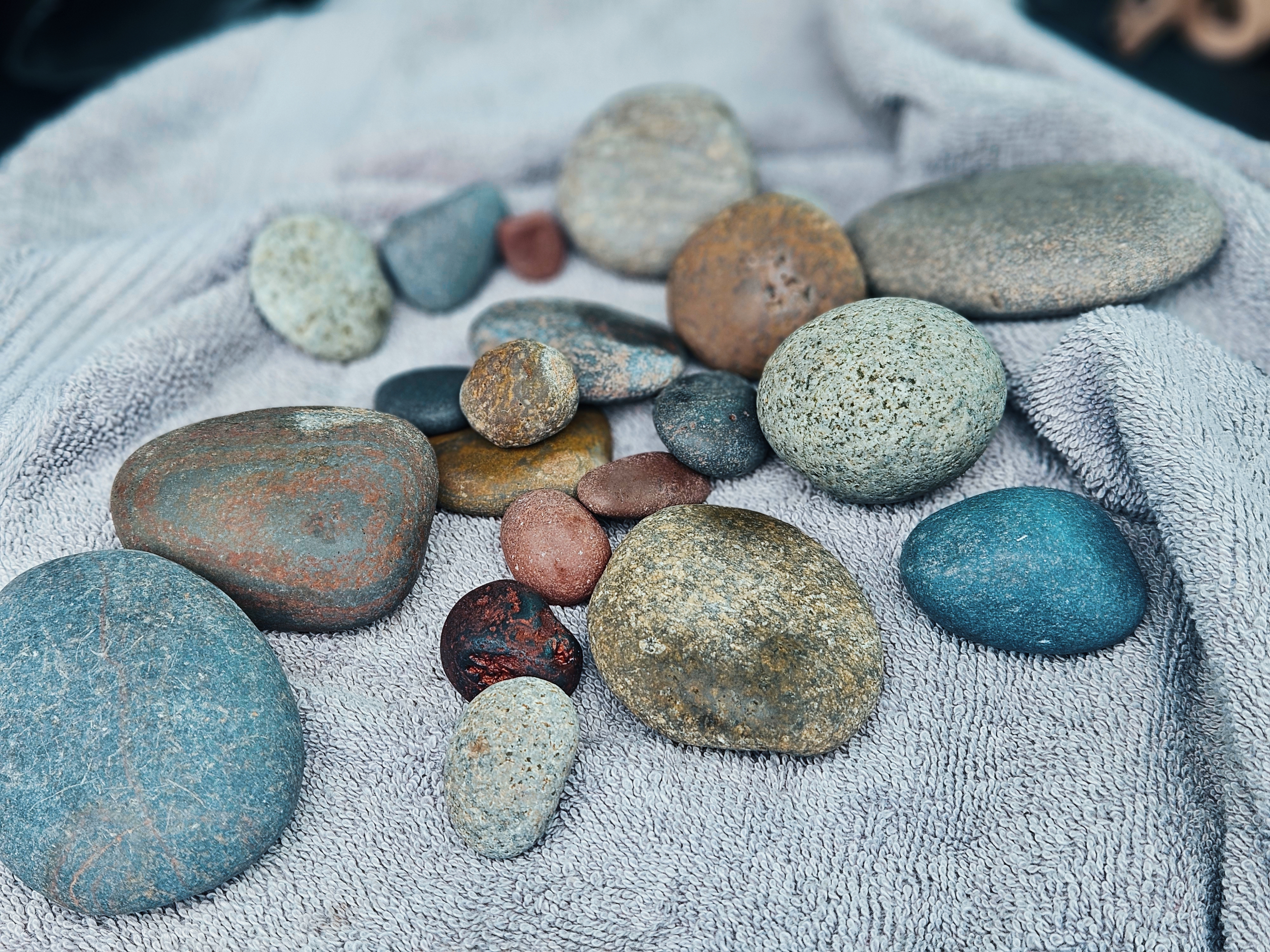
I started collecting pebbles on a black beach in Iceland.

I don’t remember deciding to do it. I only remember noticing one.

Then another.

One was pale and smooth. Another was dark, almost blue. One had a sharp edge; another fit softly into the curve of my palm. I began arranging them beside one another, comparing color, texture, size, and shape.

And something curious happened.

Every new pebble made the ones already in my collection more distinct.

The dark stone became darker beside the pale one. The smooth stone became smoother beside the jagged one. The small one did not disappear next to the larger stone; its smallness became more visible.

Each rock became more itself through connection to the new ones.

Maybe that was what Iceland wanted me to notice.

Beauty did not come from sameness.

It emerged through relation.

The lava caves were lovely beside the glaciers. The waterfalls were kinetic and majestic beside the silence of a lagoon. Fire lived beside ice. Ancient expanses of volcanic rock existed beside flowers soft enough to move with the wind.

And somewhere among all that grandeur was a silly little geyser erupting on cue, as though God had included a strict commitment to solemnity comic timing in the landscape.

There was so much unique beauty in every expression of God’s creative splatter.

Nothing had to become less itself in order to belong to the whole.

Later, when I looked through the pictures I had taken, I realized I had been collecting moments in much the same way I had collected the stones.

They were not simply “photographs of Iceland”.

They were photographs of Iceland through my eyes.

I had photographed a tiny human reaching toward a cat. A red door in an ordinary wall. A little statue of stacked pebbles that a stranger had left behind for other strangers to find and adore.

I photographed the things in which I found stories.

Or perhaps I did not have to find them.

Perhaps I only had to slow down enough to notice where the stories already lived.

A door suggested someone leaving and returning home. A child reaching toward a cat held an entire exchange of curiosity and tenderness. The pebble statue carried the touch of a person I would never meet—someone who had paused, arranged what was already there, and left a small act of meaning behind.

Maybe that is what I do too.

I place my attention beside something and say:

This was alive. This mattered. I was here.

Even the photographs carried my thumbprint.

My life is my meaning-making, my canvas, my stories, my connections—unique, odd, idiosyncratic.

Iceland did not look exactly the same through anyone else’s eyes because no one else had lived my life before standing there.

But I was not the only one creating meaning.

Life was moving through me too.

Water moves around stone without asking it to stop being stone. It finds the cracks. It travels along sharp edges. It softens, widens, shapes, and carries.

The natural forces of Iceland have been working upon the land for ages—fire rising through fissures, glaciers carving valleys, water wearing paths through rock.

Life has been shaping me in much the same way.

I make meaning from what happens to me.

And, what happens to me makes me.

Both are true.

Perhaps that is why I am becoming more like a turtle.

I want to carry my home with me.

Not because I no longer need anyone. Not because I want to retreat from the world. But because I am beginning to understand that home cannot only be a place other people allow me to occupy.

I want it beneath me.

Around me.

Within me.

I want to be able to enter caves, lagoons, airports, family rooms, and unfamiliar parts of myself without leaving home behind.

Iceland taught me that the extraordinary is usually right under my nose.

It was in the smell of coffee before I tasted it.

It was in the distinct cadence of laughter moving through the Airbnb family room.

I had traveled thousands of miles to watch volcanoes erupt—to see the earth release what it had been holding beneath its surface.

Then, one evening, the eruption began with my dad’s loud voice.

My sister’s soprano smile rose next. Ahad’s tenor thunder rolled beneath it. Liz’s legato laughter stretched warmly across the room, while my mother’s metrical laugh kept its own unmistakable rhythm.

One voice triggered another until the entire room erupted.

Different pitches. Different tempos. Different expressions of the same living force.

For a moment, the Airbnb family room became another Icelandic landscape.

No sound disappeared into the others. Each laugh became more distinct in relation to the ones surrounding it.

Another pebble collection.

Another strange and beautiful arrangement of life.

Iceland taught me to slow down enough to hear it.

In the lagoons and caves, I found myself quietly praying over strangers.

People from different countries, languages, histories, beliefs, and walks of life were gathered there for one small blip of time, exploring the natural wonders of the world together.

Some of us could not communicate with words.

But we smiled.

We noticed.

I remember looking around and thinking:

What are the chances that we are all doing this together?

Strangers sharing warm water beneath a cold sky.

Different bodies. Different lives. Different stories.

All of us briefly held by the same landscape.

In the language of the Buddha, I was nobly born.

We all were.

Just like the landscapes in the land of fire and ice—not because they were smooth, peaceful, or alike, but because each expression belonged fully to life.

I did not arrive at that understanding from somewhere above myself.

I smelled it in the coffee.

I heard it in the eruption of laughter.

I felt it in the lagoon water moving around my body.

I saw it in a tiny hand reaching toward a cat.

The sacred did not arrive as an idea.

It was already there, beneath us and between us, waiting to be noticed.

I thought Blog 4 was supposed to be about hope.

For a while, I believed I needed to find more of it.

More evidence. More answers. More transformation. Something dramatic enough to carry home and present as proof that I had changed.

But Iceland showed me that it was not about more.

It was about what lay before me.

The pebble already beneath my feet.

The laughter already moving through the room.

The strangers already sharing the water.

The sacredness already living beneath our particular shapes.

The stories already waiting inside ordinary things.

I found myself circling the same question internationally.

What would happen if I stopped treating myself as the manager of life—and became somewhere life liked to happen?

Not becoming better at life.

Not learning how to arrange it more beautifully.

Just becoming more available to it.

I want to live in a way that Life enjoys living through me.

Iceland wanted me to notice.

And perhaps hope begins there—not in forcing life to become something else, but in slowing down enough to see that life is already moving.

Through water and stone.

Through strangers and family.

Through the cracks and sharp edges of my own particular shape.

I went to Iceland looking for wonder.

I came home realizing that wonder had been looking through me all along.

One Sentence, No Bouquets

Last time, I wrote about the tiny oks.

The small replies that told me connection had not disappeared entirely. The quiet evidence that even after rupture, love still had somewhere to land.

I called them hope.

I still believe that.

But repair has layers.

Sometimes repair is a tiny “ok”.

Sometimes it is an apology.

And sometimes, before an apology can become honest, we have to learn the difference between taking responsibility and disappearing.

Which, honestly, is deeply inconvenient, because disappearing has historically been one of my more efficient skill sets >__<

Not healthy.

But efficient.

For a long time, apology felt less like accountability and more like an emergency evacuation.

I am sorry.
Please do not leave.
I am sorry.
Please stop being angry.
I am sorry.
I will become whatever version of me makes this moment end.

Trauma can teach us to confuse apology with safety.

It can teach us that the fastest way back into connection is to absorb the entire rupture — to become the mistake, the hurt, and the solution all at once.

So we apologize quickly.

Beautifully, even.

We explain ourselves with trembling precision. We search the other person’s face for evidence that the danger has passed. We offer context, remorse, reassurance, and sometimes far more of ourselves than the moment asked us to give.

Some of us do not arrive with an apology.

We arrive with a full floral arrangement.

A tasteful one, obviously. 💐

Every flower carefully selected to prove that we are good, sorry, harmless, lovable, self-aware, emotionally evolved, and safe to keep.

A very humble bouquet.

But an apology is not a bouquet.

It is not a performance of pain.

It is not a public relations campaign for our own goodness.

It is not self-erasure dressed as maturity.

And it is not the promise that I will never inconvenience another nervous system again.

Which is unfortunate, because that would be a very tempting contract to sign.

A real apology is quieter.

It says:

I see what happened.

I care about the impact.

I understand what belonged to me.

I want to become safer.

No bouquet required.

🕯️

I am learning that accountability can contain an “and.”

I am sorry, and I am still here.

You are allowed to be angry, and I do not have to abandon myself to survive your anger.

The “and” is where truth becomes large enough to hold more than one person at a time.

That sounds simple when I write it.

Alas, it does not always feel simple inside my body.

Recently, during a hard moment with my daughter, I felt the familiar pull to do too much.

To explain too quickly.

To soften every edge.

To make the discomfort disappear before either of us had understood what happened.

I wanted to repair immediately, but beneath that urgency was something less noble and more human:

I wanted relief.

I wanted the room to stop feeling difficult.

I wanted reassurance that I was still a “good mother” before I had fully listened to the child in front of me.

That is humbling to admit.

Rude, even.

But true.

So instead, I tried one sentence:

“You are allowed to be mad and I love you; we will talk when we are both in our calm bodies.”

It was not yet an apology.

It was not the full repair.

It was a boundary, a reassurance, and a pause.

It was me refusing to choose between connection and steadiness.

Later, when I could speak without trying to escape the feeling in the room, I apologized for what was mine.

Not for having a limit.

Not for needing time.

Not for being human.

But, for my tone.

For the way my overwhelm had entered the room before my words did.

For the part of the moment I could genuinely repair.

That distinction still feels new to me.

I can apologize for how I spoke and keep the boundary I was trying to communicate.

I can regret my impact and remain curious about what overwhelmed me.

I can say, “I was wrong,” without saying, “I am wrong.”

This is not an argument for partial accountability.

It is an argument for honest accountability.

The kind that changes behavior because it is rooted in truth, not panic.

The kind that asks:

  • What happened inside me?
  • What did the other person experience?
  • What belongs to me now?

Because if we aren’t careful, an apology can become another way to rush past rupture….and straight into the theatrics.

We say sorry. Everyone exhales.

The emotional smoke alarm quiets down. Whew.

And….then we rebuild the same moment again because no one stayed long enough to understand what made it possible.

Sometimes, the apology is the sentence.

Sometimes, I wonder if the deeper apology is what happens afterward.

The pause.

The changed pattern.

The willingness to notice sooner.

The refusal to make another person carry the full weight of what we have not yet learned how to hold.

But changed behavior cannot grow from self-hatred forever.

Eventually, shame becomes too small a room for transformation.

And, I have spent enough time trying to renovate that room.

🤍

I am still learning how to apologize without disappearing.

How to let another person have their hurt without making their hurt the final definition of “me”.

How to say:

I see what happened.
I care about the impact.
I will repair what is mine.
And I am still here.

That last sentence may be the hardest one.

I am still here.

Not hiding inside shame.

Not arranging an emotional bouquet large enough to earn my way back into love.

Not promising to become so careful, useful, or good that no one will ever feel pain near me again.

Just here.

Human.

Accountable.

Loved.

Learning.

For much of my life, I thought repair meant restoring everything to the way it was before the rupture.

Now I wonder whether real repair sometimes creates something entirely new.

A little more truth.

A little more room.

A relationship capable of staying present after something hard has happened.

Maybe that is why the tiny oks mattered so much.

They were not evidence that nothing had happened.

They were evidence that something could happen and connection could remain.

That rupture did not always have to become abandonment.

That love could be disappointed and still stay.

That accountability did not require annihilation.

And perhaps, after a lifetime of preparing for what might go wrong, that is how the nervous system first begins to consider another possibility:

What if something goes right?

What if love stays?

What if repair is not only the end of rupture, but the beginning of our capacity to receive?

One sentence.

No grand performance.

No bouquets.

Just enough room for hope to enter without being chased away.

Till next time

The Tiny Oks Are Hope

On repair, motherhood, and the words we did not erase.

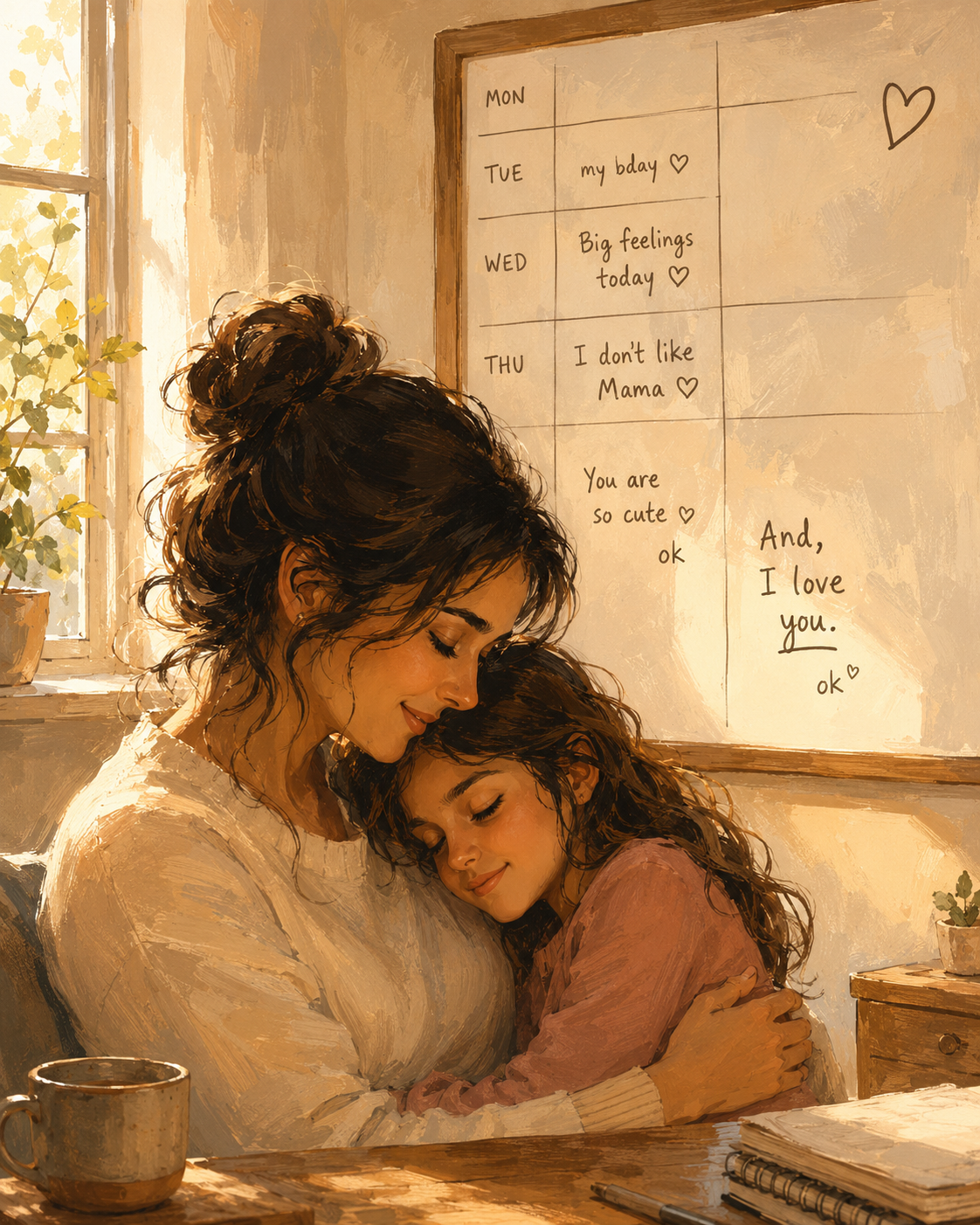
My daughter wrote “I don’t like Mama” on our weekly planner.

Then, a little later, I wrote:

“And I love you.”

By the end of the day, underneath my repair words, she had added the smallest possible offering:

ok.

Not a grand apology.

Not a cinematic hug with swelling music and one tasteful tear.

Not one of those soft-focus parenting moments where everyone wears linen and speaks in nervous-system-approved whispers.

Just dry-erase marker.

A hard day.

A rupture that did not become the ending.

And two tiny letters that felt like hope.

Because here is what I am learning: repair does not always look beautiful while it is happening.

Sometimes repair looks like a child writing the thing she feels before she knows how to say it gently.

Sometimes repair looks like a mother feeling the sting of those words and choosing not to make the child responsible for that sting.

Sometimes repair looks like writing back:

“You are so cute.”

“I’m sorry today felt so big.”

“And I still love you”

And sometimes, after all of that, repair looks like a tiny ok written underneath your words.

The tiny oks are hope because they prove something quietly revolutionary:

Rupture happened, and love still had somewhere to land.

For a long time, I thought good mothering meant preventing rupture.

If my child was upset with me, I had failed.

If I reacted, I was becoming everything I feared.

If repair was not immediate, eloquent, complete, and preferably witnessed by a small panel of experts confirming I had not ruined my child forever, it probably did not count.

But motherhood is teaching me something much less glamorous and much more holy:

Repair is not the absence of rupture.

Repair is what happens when rupture is allowed to be real, but not allowed to write the whole story.

Repair, I am learning, is not asking my child to reassure me.

It is showing her that I can stay present without making her feelings dangerous.

If my first post was about “The Girl With the List”, this one might be about what happens when List Girl has to mother.

“The Girl With the List” likes preparation. She likes structure. She likes the fantasy that if she can plan enough, anticipate enough, understand enough, and make the correct emotional spreadsheet, then no one will get hurt.

She is not bad.

She is trying to love through planning.

But motherhood does not always honor the list.

Children have feelings on their own timeline.

Repair does not arrive color-coded.

And some of the most important moments in a relationship cannot be controlled into safety.

They can only be met.

The list can stay.

But it cannot mother for me.

My daughter does not live with me year-round. She comes to visit in the summers, and that time is deeply precious to me. It is also a transition.

Each summer is a kind of re-entry: a new rhythm, a beloved disruption of routine, a closeness I ache for and still have to adjust to.

For someone with a very active inner world — a whole inner cast ready to offer commentary at any given moment — it can take my nervous system a beat to catch up.

Not because she is too much.

Because she matters so much.

Love raises the stakes.

And sometimes my nervous system is still catching up to what my heart already knows.

We did not erase her words.

We did not write over them.

We did not pretend “I don’t like Mama” had not been written.

We also did not let those words become the final sentence.

We let them exist.

We let them breathe.

And then, underneath them, around them, beside them, we made room for something else too:

Love.

Apology.

Connection.

A tiny ok.

I think that is what feels so different to me.

So much pain gets passed down through erasure:

That did not happen.

You are too sensitive.

You are fine.

And so much pain also gets passed down through writing over someone else’s experience:

Here is what you should feel.

Here is why your hurt is inconvenient.

Here is why my shame matters more than your truth.

But this time, we did something else.

We left the words on the board.

We let the feeling have a place.

And then we practiced coming back.

This is also complicated for me because I have spent years working with children. I have been a teacher, a nanny and a counselor. With other children, I can often access patience and curiosity more easily. I can observe. I can regulate. I can remember that behavior is communication.

But with my own daughter, more of “me” enters the room.

Not less skill.

More history.

More longing.

More fear.

More grief.

More hope.

More old wounds whispering, “Don’t mess this up,” while holding a clipboard and several pieces of unsolicited evidence.

Mothering is not harder because I know less.

Mothering is harder because more of me shows up.

And that is the part I am learning how to meet: the part of me that panics when my daughter is upset, thinks one hard moment means I have ruined everything, and forgets children do not need perfect parents.

They need parents who can come back.

So this week, I am trying to let the tiny oks count — to let repair be evidence that a hard moment is not the whole story.

Because there is proof all around me, if I look toward the light, that love finds us even after mistakes.

A child can write “I don’t like Mama” and still love her.

A mother can feel hurt and still stay soft enough to repair.

A rupture can happen, and the relationship can survive it.

A tiny ok can become a doorway.

Maybe healing does not always arrive loudly.

Maybe it does not look like a breakthrough.

Maybe sometimes healing is just two small letters written underneath an apology.

Maybe sometimes it is both of us saying, in the smallest handwriting possible:

This is not how our story will end.

<3, List Girl: Mothering Edition

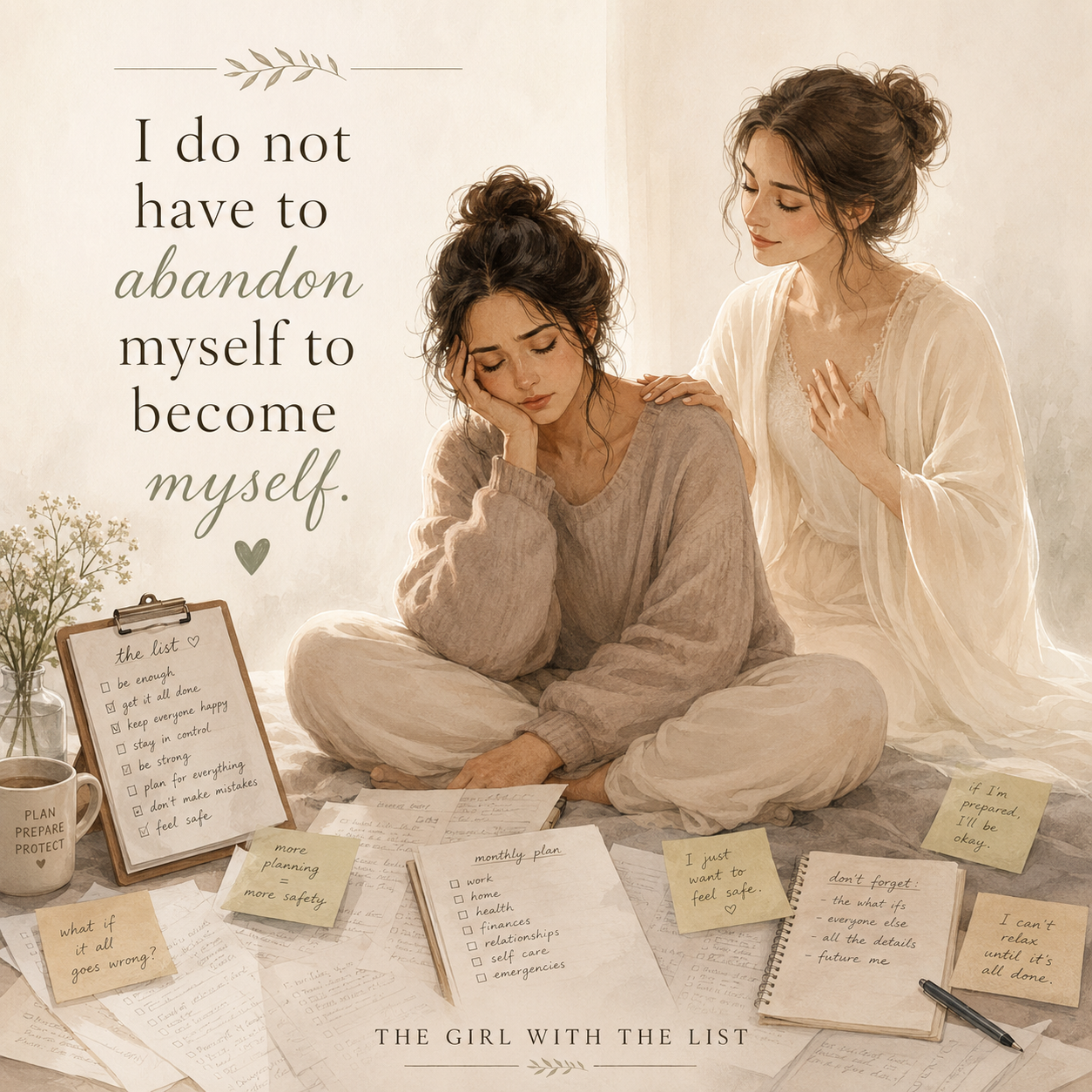
The Girl With the List

There is a girl inside me who believes that if she can make a good enough list, she can finally feel safe.

Not a normal list.

A sacred list.
A survival list.
An “if I can just get all of this out of my head and onto paper, maybe my body will stop acting like there is a lion in the kitchen” list.

📝

She writes down everything.

The appointments.
The errands.
The texts she needs to answer.
The people she might have disappointed.
The gifts she still needs to wrap.
The book she wants to write.
The blog she wants to start.
The life she is trying to build.
The version of herself she is trying very hard to become.

A casual Tuesday, basically.

She is efficient, this girl.

She is also exhausted.

And dramatic.

Not just regular dramatic. More like, “If we don’t reorganize our entire life before 11:43 a.m., we may never fulfill our destiny” dramatic.

For a long time, I mistook her for discipline. I thought she was ambition. I thought she was proof that I was trying, growing, healing, becoming.

And she is trying.

But she is also (so) afraid.

🕯️

Afraid that if she slows down, everything will fall apart.
Afraid that if she forgets one thing, she will become one thing: unreliable.
Afraid that rest will be mistaken for failure.
Afraid that if she stops managing the whole universe, the whole universe will finally have the audacity to manage itself without her.

Rude, honestly 😒

Sometimes I catch her in the act.

There I am, allegedly “taking a break,” except my break has somehow become a 17-step plan for emotional liberation, financial stability, spiritual enlightenment, and possibly reorganizing the pantry.

Because why simply drink water when you could also create a five-year plan? 🤦‍♀️

Why feel one feeling when you could build a comprehensive nervous system operating manual and assign it subheadings?

🌿

But lately, through EMDR, IFS, motherhood, and the deeply humbling experience of being human, I am beginning to understand something:

The list is not the problem.

The list is a part.

A protector.

A little clipboard-holding manager inside me who learned a long time ago that being prepared was safer than being present.

She does not need to be shamed.
She does not need to be fired.
She needs to be witnessed.

Because underneath the list is usually a feeling.

Grief.
Fear.
Shame.
The ache of wanting to be held.
The terror of being needed when I already feel empty.
The old belief that I have to earn my right to rest.

And when I only add more tasks, I never reach the feeling. I just create a more organized form of avoidance.

A very color-coded dissociation, if you will.

🤍

There is another part of me now, though. A quieter one. A slower one.

She does not hate the girl with the list.

She actually kind of respects the hustle.

But she also gently asks:

What are we afraid will happen if we pause?
What feeling are we trying to outrun?
What if the next right thing is not the most productive thing, but the most honest one?

This question is deeply inconvenient.

I would personally prefer a spreadsheet.

I used to think healing meant finally becoming the kind of person who could do everything.

Now I wonder if healing means becoming the kind of person who no longer needs to.

The list can stay.

But it cannot be God.

It cannot be my worth.
It cannot be my mothering.
It cannot be my authorship.
It cannot be the measure of whether I am becoming who I am meant to be.

Sometimes the bravest thing I can do is not cross off another task.

Sometimes it is to put the pen down, place one hand on my chest, and say:

I am here.
I am not behind.
I do not have to abandon myself to become myself.

And yes, the list girl may still whisper, “Okay, but should we make a list about how to stop making lists?”

Bless her.

We love her.

We are not letting her drive.

Maybe that is where the real list begins.

Not with everything I have to do.

But with everything I am finally allowed to feel.

Till next week…

<3,

List Girl