
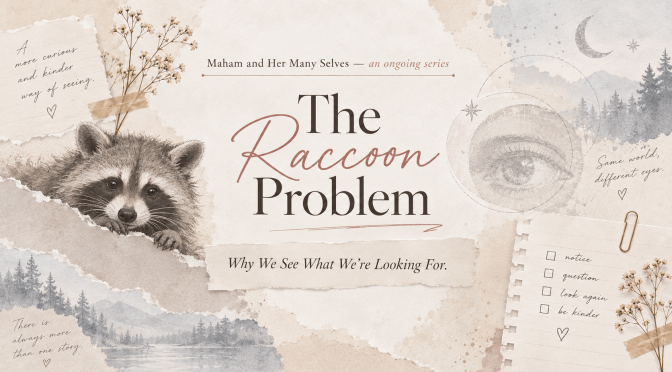
Why We See What We’re Looking For
I do not remember when I first realized raccoons were weird. Perhaps in Pocahontas. Meeko was kind of my hero. Him and Mushu.
Maybe it was the tiny masked face. Maybe it was the suspicious little hands. Maybe it was the way they appear in the world with the confidence of a creature that knows exactly what it is doing, even when it is absolutely unclear to the rest of us.
Raccoons look like they know something.
And because humans are humans, we immediately begin filling in the blanks.
We call them clever. Mischievous. Adorable. Annoying. Little forest bandits.
But here is the strange part:
The raccoon did not change.
Our perception of the raccoon did.
I know, I know. Just follow me here in good faith.
The world around us is constantly offering information, but we do not experience it like a security camera. We sort it. Translate it. Attach stories to it. Decide what matters and what gets shoved into the background.
I once went to an estate sale and came home convinced an inanimate object had a story to tell me.
We’ll come back to that.
And apparently, we start doing this before we even know we’re doing it.
Light enters the eye and hits the retina, and somewhere between light exists and oh, that’s a raccoon, your visual system has already started sorting.
The retina is not just sitting back there taking pictures.
It notices things.
Edges. Contrast. Movement. Changes in light.
Which means that before your conscious brain gets the memo, some part of you is already asking:
What is this?
Have I seen this before?
Does this matter?
Should I remember it?
This is why, after learning a new word, suddenly you seem to see it everywhere. Why a song you have not heard in years appears three times in one week. Why you can recognize a friend’s walk from across a parking lot before you can see their face.
The world did not suddenly become full of that thing.
Your attention changed.
And this is where the raccoon problem begins.
Because the same human system that allows us to find patterns can also create illusions.
We see faces in clouds. We find shapes in shadows. We connect moments together and create stories.
Sometimes those stories are wrong.
But sometimes?
Sometimes that same ability is what allows us to create art, recognize kindness, build relationships, and notice what others overlook.
The human brain is not only a machine for survival.
It is a machine for meaning.
Which is inconvenient, because now we have a new problem.
If we are always interpreting what we see, then how do we know when we are noticing something real and when we are simply noticing ourselves?
I do not think the answer is to stop looking for patterns.
That sounds healthy and reasonable.
Yes
And probably impossible.
Maybe the better question is whether we can stay curious about what we notice without immediately turning it into certainty.
Because there is a difference between:
That meant something to me.
and
That means something.
A small difference in language.
A massive difference in posture.
And honestly, I am still learning it.
The raccoon is still there.
The little masked creature, standing in the dark, looking like it knows a secret.
Maybe he does.
Maybe he just wants the cat food.
I’m learning to leave room for both.
❤
 abidmaham